
Generate, review, and optimize code with Cursor AI, GitHub, Google, and Slack

Workflow preview
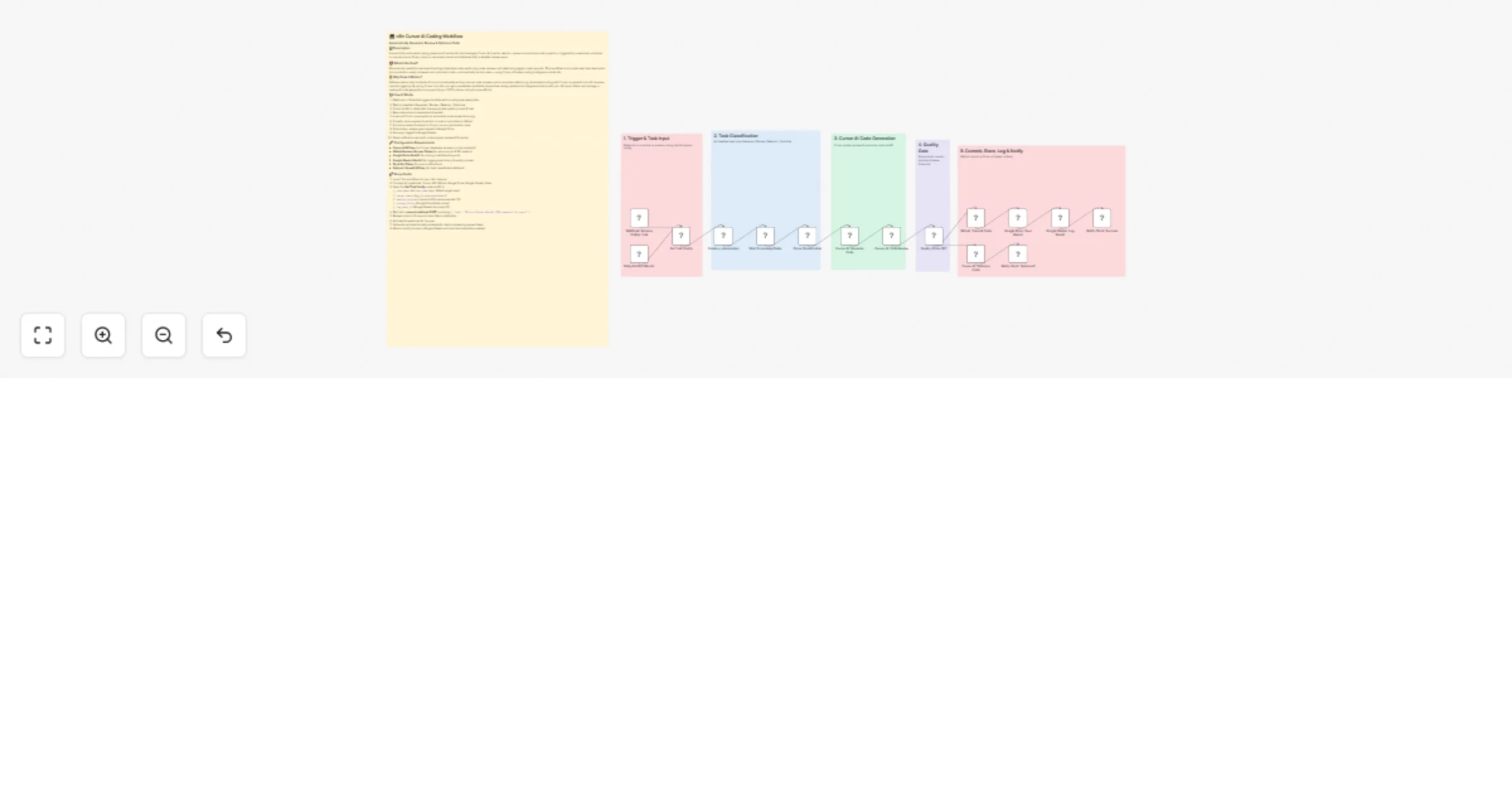
Workflow preview
100%
Generate, review, and optimize code with Cursor AI, GitHub, Google, and Slack preview
Open on n8n.io

1. Workflow Overview

A smart, fully automated coding pipeline built inside n8n that leverages Cursor AI to write, refactor, review, and optimize code projects — triggered by a webhook, schedule, or manual prompt. Every...

Best for

  • Engineering automation workflows
  • Multimodal AI automation workflows
  • advanced n8n builders looking for reusable templates

Tools used

n8n-nodes-base.stickynote, n8n-nodes-base.webhook, n8n-nodes-base.scheduletrigger, n8n-nodes-base.set, n8n-nodes-base.code, n8n-nodes-base.httprequest, n8n-nodes-base.wait, n8n-nodes-base.if

Source and attribution

This workflow is cataloged by N8N Workflows and links back to its original n8n.io source page by Oneclick AI Squad.

Original n8n.io source

1.1 Workflow description

Title
Generate, review, and optimize code with Cursor AI, GitHub, Google, and Slack
Workflow name
Generate, review, and optimize code with Cursor AI, GitHub, Google, and Slack

A smart, fully automated coding pipeline built inside n8n that leverages Cursor AI to write, refactor, review, and optimize code projects — triggered by a webhook, schedule, or manual prompt. Every output is versioned, stored, and delivered with a detailed review report.


🎯 What's the Goal?

Eliminate the repetitive overhead of writing boilerplate code, performing code reviews, and refactoring legacy code manually. This workflow turns a plain-text task description into production-ready, reviewed, and optimized code — automatically and at scale — using Cursor AI's deep coding intelligence inside n8n.


💡 Why Does It Matter?

Software teams lose hundreds of hours to boilerplate writing, manual code reviews, and inconsistent refactoring. AI-assisted coding with Cursor is powerful, but still requires manual triggering. By wiring Cursor into n8n, you get a repeatable, auditable, hands-free coding pipeline that integrates directly with your Git repos, Slack, and storage — making AI code generation a true part of your CI/CD culture, not just a one-off tool.


⚙️ How It Works

  1. Webhook or Schedule triggers the flow with a coding task description
  2. Task is classified (Generate / Review / Refactor / Optimize)
  3. Cursor AI API is called with the appropriate system prompt & task
  4. Raw code output is received and parsed
  5. A second Cursor pass performs automated code review & scoring
  6. If quality score passes threshold → code is committed to GitHub
  7. If score is below threshold → Cursor runs an optimization pass
  8. Final code + review report saved to Google Drive
  9. Summary logged to Google Sheets
  10. Slack notification sent with code snippet preview & Drive link

🔧 Configuration Requirements

  • Cursor AI API key (via Cursor developer access or proxy endpoint)
  • GitHub Personal Access Token (for auto-commit & PR creation)
  • Google Drive OAuth2 (for storing code files & reports)
  • Google Sheets OAuth2 (for logging task history & quality scores)
  • Slack Bot Token (for team notifications)
  • Optional: OpenAI API key (for task classification fallback)

🚀 Setup Guide

  1. Import this workflow into your n8n instance
  2. Connect all credentials: Cursor API, GitHub, Google Drive, Google Sheets, Slack
  3. Open the Set Task Config node and fill in:
  • repo_owner and repo_name (your GitHub target repo)
  • target_branch (e.g. ai-generated or main)
  • quality_threshold (score 0–100, recommended: 75)
  • storage_folder (Google Drive folder name)
  • log_sheet_id (Google Sheets document ID)
  1. Test with a manual webhook POST containing { "task": "Write a Python FastAPI CRUD endpoint for users" }
  2. Review output in Drive and check Slack notification
  3. Activate the webhook for live use
  4. Optionally activate the daily schedule for batch processing queued tasks
  5. Monitor quality scores in Google Sheets and tune the threshold as needed

1.2 Logical Blocks

This catalog entry is organized from the workflow JSON. The node-level section below shows the executable blocks available for review before importing the template.

2. Block-by-Block Analysis

Block 1 - Overview & Instructions

Type / Role
n8n-nodes-base.stickyNote - stickyNote
Config choices
Version 1

Block 2 - 1. Trigger

Type / Role
n8n-nodes-base.stickyNote - stickyNote
Config choices
Version 1

Block 3 - 2. Classification Phase

Type / Role
n8n-nodes-base.stickyNote - stickyNote
Config choices
Version 1

Block 4 - 3. Cursor Phase

Type / Role
n8n-nodes-base.stickyNote - stickyNote
Config choices
Version 1

Block 5 - 4. Quality Gate

Type / Role
n8n-nodes-base.stickyNote - stickyNote
Config choices
Version 1

Block 6 - 5. Output Phase

Type / Role
n8n-nodes-base.stickyNote - stickyNote
Config choices
Version 1

Block 7 - Webhook: Receive Coding Task

Type / Role
n8n-nodes-base.webhook - webhook
Config choices
Version 2

Block 8 - Daily Batch (fallback)

Type / Role
n8n-nodes-base.scheduleTrigger - scheduleTrigger
Config choices
Version 1.3

Block 9 - Set Task Config

Type / Role
n8n-nodes-base.set - set
Config choices
Version 2

Block 10 - Parse Classification

Type / Role
n8n-nodes-base.code - code
Config choices
Version 2

Block 11 - Cursor AI: Generate Code

Type / Role
n8n-nodes-base.httpRequest - httpRequest
Config choices
Version 4.2

Block 12 - Wait: Processing Delay

Type / Role
n8n-nodes-base.wait - wait
Config choices
Version 1.1

Block 13 - Cursor AI: Code Review

Type / Role
n8n-nodes-base.httpRequest - httpRequest
Config choices
Version 4.2

Block 14 - Quality Score OK?

Type / Role
n8n-nodes-base.if - if
Config choices
Version 1

Block 15 - Cursor AI: Optimize Code

Type / Role
n8n-nodes-base.httpRequest - httpRequest
Config choices
Version 4.2

Block 16 - GitHub: Commit Code

Type / Role
n8n-nodes-base.httpRequest - httpRequest
Config choices
Version 4.2

Block 17 - Google Drive: Save Report

Type / Role
n8n-nodes-base.googleDrive - googleDrive
Config choices
Version 3

Block 18 - Google Sheets: Log Result

Type / Role
n8n-nodes-base.googleSheets - googleSheets
Config choices
Version 4.4

Block 19 - Notify Slack: Success

Type / Role
n8n-nodes-base.slack - slack
Config choices
Version 1

Block 20 - Notify Slack: Optimized

Type / Role
n8n-nodes-base.slack - slack
Config choices
Version 1

Block 21 - Create a conversation

Type / Role
@n8n/n8n-nodes-langchain.openAi - openAi
Config choices
Version 2.1

3. Summary Table

Workflow Generate, review, and optimize code with Cursor AI, GitHub, Google, and Slack
Complexity advanced
Nodes 21
Categories Engineering, Multimodal AI
Author Oneclick AI Squad
Published 03 Mar 2026

4. Reproducing the Workflow from Scratch

  1. 1. Download the workflow JSON

    Use the JSON export at /data/workflows/13827/13827.json as the source template for this automation.

  2. 2. Import the template into n8n

    Open n8n, import the downloaded JSON, and review each node before activating the workflow.

  3. 3. Configure credentials and variables

    Replace placeholder credentials, API keys, webhook URLs, account IDs, and environment-specific values with your own settings.

  4. 4. Test with sample data

    Run the workflow manually or in a staging workspace, inspect node output, and confirm downstream systems receive the expected data.

  5. 5. Activate and monitor

    Enable the workflow only after testing, then monitor executions, errors, and rate limits during the first production runs.

5. General Notes & Resources

Review imported nodes carefully before activation. This catalog entry is intended to help you inspect the workflow structure, understand required services, and find related templates faster.

Node names, credentials, schedules, webhook paths, and external service limits may need adjustment for your workspace.

Frequently asked questions

What does Generate, review, and optimize code with Cursor AI, GitHub, Google, and Slack do?

A smart, fully automated coding pipeline built inside n8n that leverages Cursor AI to write, refactor, review, and optimize code projects — triggered by a webhook, schedule, or manual prompt. Every...

What do I need before importing this workflow?

Review the workflow JSON, configure any required credentials in n8n, and test the automation in a safe workspace before using it in production.

Can I customize this workflow?

Yes. Use the block-by-block analysis and the downloadable JSON to inspect each node, then adjust credentials, prompts, schedules, filters, or destinations for your Engineering, Multimodal AI use case.



