
Generate and email PDF quotes from Airtable via Gmail and Google Drive

Workflow preview
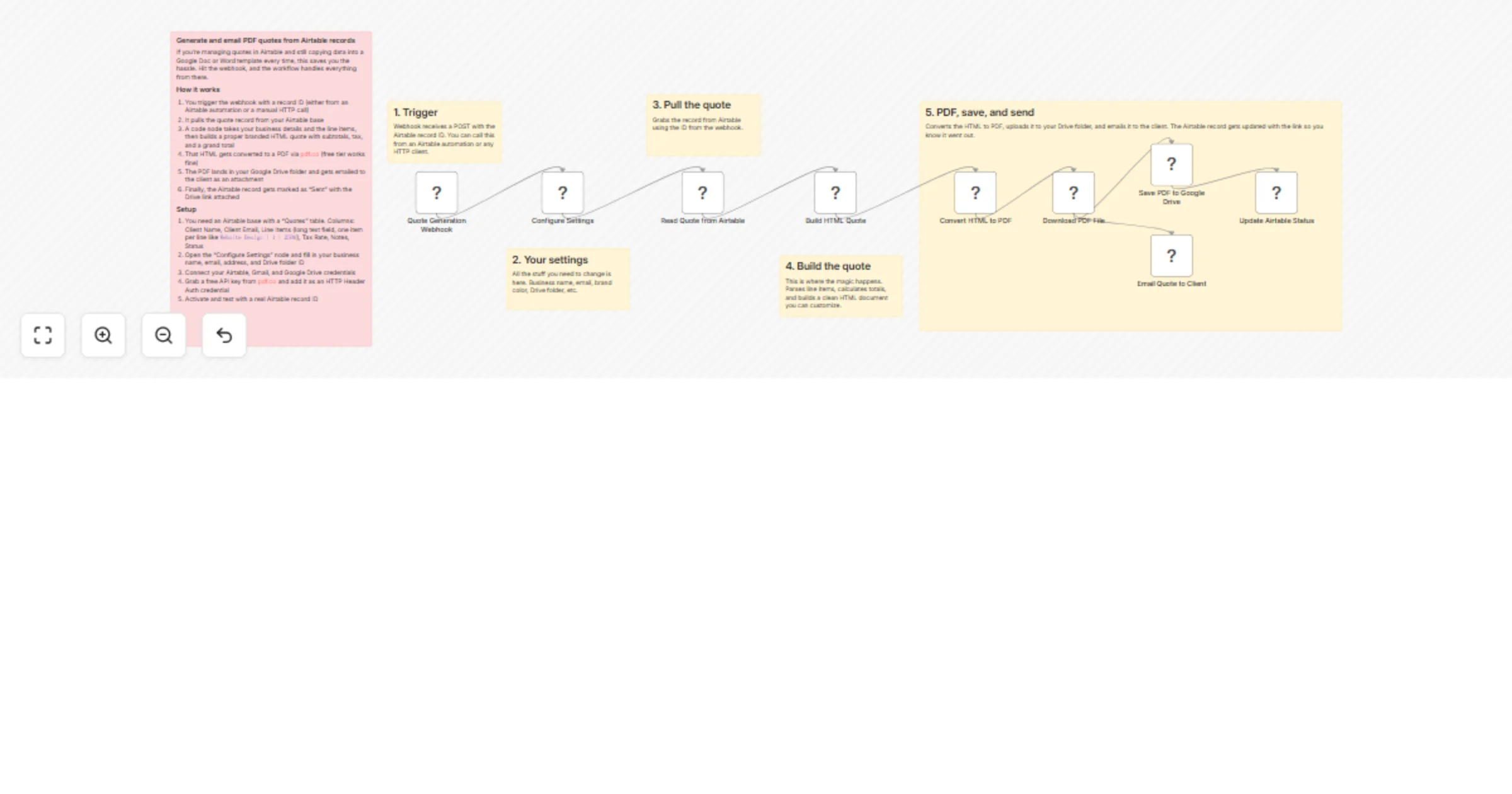
Workflow preview
100%
Generate and email PDF quotes from Airtable via Gmail and Google Drive preview
Open on n8n.io

1. Workflow Overview

Most service businesses and freelancers track their quotes in Airtable (or something similar), but when it comes to actually sending the quote, they're still manually copying data into a document, ...

Best for

  • Document Extraction automation workflows
  • advanced n8n builders looking for reusable templates

Tools used

n8n-nodes-base.stickynote, n8n-nodes-base.webhook, n8n-nodes-base.set, n8n-nodes-base.airtable, n8n-nodes-base.code, n8n-nodes-base.httprequest, n8n-nodes-base.googledrive, n8n-nodes-base.gmail

Source and attribution

This workflow is cataloged by N8N Workflows and links back to its original n8n.io source page by Anwar Bouilouta.

Original n8n.io source

1.1 Workflow description

Title
Generate and email PDF quotes from Airtable via Gmail and Google Drive
Workflow name
Generate and email PDF quotes from Airtable via Gmail and Google Drive

Most service businesses and freelancers track their quotes in Airtable (or something similar), but when it comes to actually sending the quote, they're still manually copying data into a document, exporting a PDF, attaching it to an email, and then going back to update the record. This workflow cuts all of that out.

Who is this for

Freelancers, agencies, and small service businesses who already use Airtable to track client work and want to stop manually creating quote documents. If you've ever caught yourself copying the same line items into a Google Doc for the third time in a week, this is for you.

How it works

The workflow starts with a webhook. You can call it from an Airtable automation (when a record hits "Ready to Send", for example) or trigger it manually from Postman or any HTTP client.

Once triggered, it pulls the quote record from Airtable, grabs the client details and line items, and builds a branded HTML document with proper formatting, subtotals, tax calculation, and a grand total. That HTML then gets converted to a PDF through pdf.co's free API.

From there, the PDF gets uploaded to a Google Drive folder and emailed to the client as an attachment via Gmail. The Airtable record is updated with the Drive link and marked as "Sent" so you have a clear audit trail.

How to set it up

  1. Create an Airtable base with a "Quotes" table. You'll need these columns: Client Name, Client Email, Line Items (long text, one per line in the format Description | Qty | Price), Tax Rate, Notes, and Status
  2. Open the "Configure Settings" node in the workflow and fill in your business name, email address, physical address, and Google Drive folder ID
  3. Connect your Airtable, Gmail, and Google Drive accounts in n8n
  4. Sign up for a free pdf.co account and add the API key as an HTTP Header Auth credential
  5. Activate the workflow and test it by sending a POST request with {"recordId": "rec..."} to the webhook URL

Requirements

  • Airtable account (free tier works)
  • Gmail account with OAuth connected in n8n
  • Google Drive for PDF storage
  • pdf.co API key (free tier gives you 100 credits/month, each conversion costs 1 credit)

Customizing the workflow

The HTML template lives inside the "Build HTML Quote" code node. You can change the layout, fonts, colors, and add your logo by editing the HTML string directly. The brand color is pulled from the Configure Settings node, so changing it there updates the whole document.

You can also adjust the quote validity period (default is 30 days) or change the reference number format in the same code node. If you want to swap pdf.co for another HTML-to-PDF service, just update the HTTP Request node URL and payload format.

1.2 Logical Blocks

This catalog entry is organized from the workflow JSON. The node-level section below shows the executable blocks available for review before importing the template.

2. Block-by-Block Analysis

Block 1 - Sticky Note

Type / Role
n8n-nodes-base.stickyNote - stickyNote
Config choices
Version 1

Block 2 - Sticky Note1

Type / Role
n8n-nodes-base.stickyNote - stickyNote
Config choices
Version 1

Block 3 - Sticky Note2

Type / Role
n8n-nodes-base.stickyNote - stickyNote
Config choices
Version 1

Block 4 - Sticky Note3

Type / Role
n8n-nodes-base.stickyNote - stickyNote
Config choices
Version 1

Block 5 - Sticky Note4

Type / Role
n8n-nodes-base.stickyNote - stickyNote
Config choices
Version 1

Block 6 - Sticky Note5

Type / Role
n8n-nodes-base.stickyNote - stickyNote
Config choices
Version 1

Block 7 - Quote Generation Webhook

Type / Role
n8n-nodes-base.webhook - webhook
Config choices
Version 2

Block 8 - Configure Settings

Type / Role
n8n-nodes-base.set - set
Config choices
Version 3.4

Block 9 - Read Quote from Airtable

Type / Role
n8n-nodes-base.airtable - airtable
Config choices
Version 2.1

Block 10 - Build HTML Quote

Type / Role
n8n-nodes-base.code - code
Config choices
Version 2

Block 11 - Convert HTML to PDF

Type / Role
n8n-nodes-base.httpRequest - httpRequest
Config choices
Version 4.2

Block 12 - Download PDF File

Type / Role
n8n-nodes-base.httpRequest - httpRequest
Config choices
Version 4.2

Block 13 - Save PDF to Google Drive

Type / Role
n8n-nodes-base.googleDrive - googleDrive
Config choices
Version 3

Block 14 - Email Quote to Client

Type / Role
n8n-nodes-base.gmail - gmail
Config choices
Version 2.1

Block 15 - Update Airtable Status

Type / Role
n8n-nodes-base.airtable - airtable
Config choices
Version 2.1

3. Summary Table

Workflow Generate and email PDF quotes from Airtable via Gmail and Google Drive
Complexity advanced
Nodes 15
Categories Document Extraction
Author Anwar Bouilouta
Published 19 Mar 2026

4. Reproducing the Workflow from Scratch

  1. 1. Download the workflow JSON

    Use the JSON export at /data/workflows/14174/14174.json as the source template for this automation.

  2. 2. Import the template into n8n

    Open n8n, import the downloaded JSON, and review each node before activating the workflow.

  3. 3. Configure credentials and variables

    Replace placeholder credentials, API keys, webhook URLs, account IDs, and environment-specific values with your own settings.

  4. 4. Test with sample data

    Run the workflow manually or in a staging workspace, inspect node output, and confirm downstream systems receive the expected data.

  5. 5. Activate and monitor

    Enable the workflow only after testing, then monitor executions, errors, and rate limits during the first production runs.

5. General Notes & Resources

Review imported nodes carefully before activation. This catalog entry is intended to help you inspect the workflow structure, understand required services, and find related templates faster.

Node names, credentials, schedules, webhook paths, and external service limits may need adjustment for your workspace.

Frequently asked questions

What does Generate and email PDF quotes from Airtable via Gmail and Google Drive do?

Most service businesses and freelancers track their quotes in Airtable (or something similar), but when it comes to actually sending the quote, they're still manually copying data into a document, ...

What do I need before importing this workflow?

Review the workflow JSON, configure any required credentials in n8n, and test the automation in a safe workspace before using it in production.

Can I customize this workflow?

Yes. Use the block-by-block analysis and the downloadable JSON to inspect each node, then adjust credentials, prompts, schedules, filters, or destinations for your Document Extraction use case.



