Generate AI incident reports with GPT-4, Slack alerts, Gmail and PDF export
Workflow preview


 Early Deal
DISCOUNT 20%

Important notice
This workflow is provided as-is. Please review and test before using in production.
Overview
AI-Powered Incident Report Generator with Severity Alerts & PDF Delivery
Description
Automate incident reporting from detection to delivery with AI-driven analysis and professional documentation.
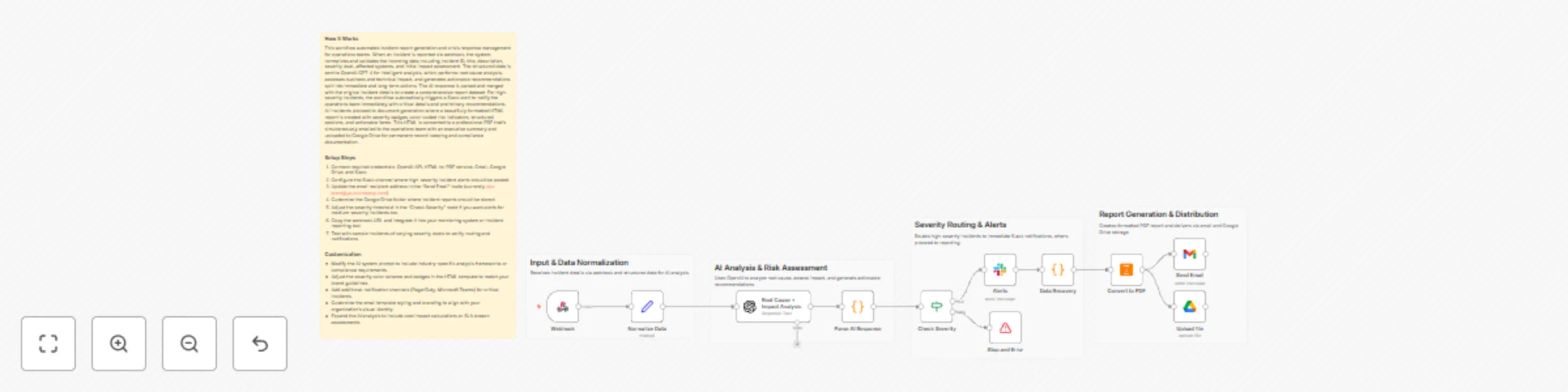
This workflow transforms raw incident details into a clear, structured incident report, performs AI-based root cause and impact analysis, triggers real-time alerts for high-severity issues, and delivers a polished PDF report to your operations team — all with minimal manual effort.
What This Workflow Does
Turns incident reporting into a fast, reliable, and repeatable process:
🚨 Receive Incident Details – Accepts incident data via webhook (ID, severity, systems affected, description).
🧠 AI Analysis – Uses AI to generate root cause analysis, impact assessment, and recommended actions.
⚠️ Severity Check – Automatically detects high-severity incidents.
💬 Slack Alerts – Sends instant alerts for critical incidents to the ops channel.
📄 Professional Report Generation – Formats incident details into a clean, readable report.
📑 PDF Creation – Converts the report into a downloadable PDF.
📧 Email Delivery – Sends the report to the operations team.
☁️ Secure Storage – Saves a copy to Google Drive for records and compliance.
Key Features
🤖 AI-Generated Analysis – Automated root cause, impact, and action recommendations ⚡ Real-Time Severity Alerts – Immediate Slack notifications for high-risk incidents 📄 Professional PDF Reports – Clean, structured, and ready for audits 📧 Automated Delivery – Email reports without manual follow-ups ☁️ Centralized Storage – Securely archive reports in Google Drive
Perfect For
🏢 IT & Operations Teams 🔐 Security & Compliance Teams 🧑💼 Internal Ops & Risk Management 🏭 Enterprises handling system or process incidents 📊 Teams needing audit-ready incident documentation
What You’ll Need
Required Integrations
🤖 OpenAI – Incident analysis and recommendations 📄 HTMLCSS to PDF – Convert reports into PDFs 📧 Gmail – Send incident reports 💬 Slack – Severity-based alerts
Optional
☁️ Google Drive – Store incident reports securely
Quick Start
1️⃣ Import the workflow into n8n 2️⃣ Connect OpenAI, Slack, Gmail, and HTMLCSS to PDF credentials 3️⃣ Update Slack channel and email recipients 4️⃣ Trigger the webhook with incident data 5️⃣ Activate the workflow
Expected Results
⚡ Faster incident response 🤖 Consistent AI-driven analysis 📉 Reduced manual reporting work 📄 Audit-ready incident documentation 🚨 Immediate visibility into critical incidents