
Evaluate AI agent response correctness with OpenAI and RAGAS methodology

Workflow preview
Workflow preview
100%
Evaluate AI agent response correctness with OpenAI and RAGAS methodology preview
Open on n8n.io

Important notice

This workflow is provided as-is. Please review and test before using in production.

1. Workflow Overview

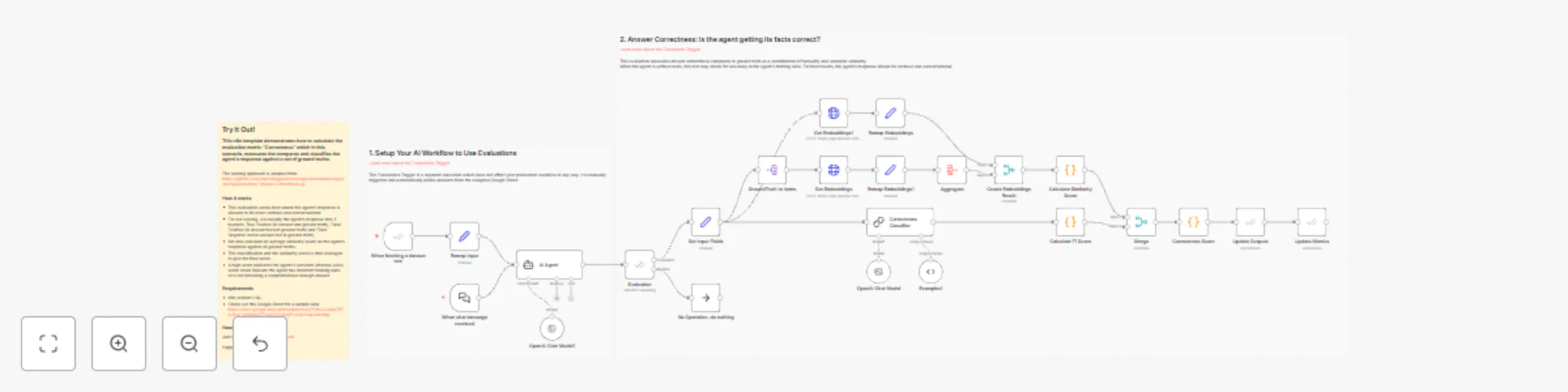
This n8n template demonstrates how to calculate the evaluation metric "Correctness" which in this scenario, measures the compares and classifies the agent's response against a set of ground truths....

Best for

  • Engineering automation workflows
  • AI Summarization automation workflows
  • advanced n8n builders looking for reusable templates

Tools used

@n8n/n8n-nodes-langchain.chainllm, @n8n/n8n-nodes-langchain.outputparserstructured, @n8n/n8n-nodes-langchain.lmchatopenai, n8n-nodes-base.evaluationtrigger, n8n-nodes-base.set, n8n-nodes-base.evaluation, n8n-nodes-base.noop, @n8n/n8n-nodes-langchain.agent

Source and attribution

This workflow is cataloged by N8N Workflows and links back to its original n8n.io source page by Jimleuk.

Original n8n.io source

1.1 Workflow description

Title
Evaluate AI agent response correctness with OpenAI and RAGAS methodology
Workflow name
Evaluate AI agent response correctness with OpenAI and RAGAS methodology

This n8n template demonstrates how to calculate the evaluation metric "Correctness" which in this scenario, measures the compares and classifies the agent's response against a set of ground truths.

The scoring approach is adapted from the open-source evaluations project RAGAS and you can see the source here https://github.com/explodinggradients/ragas/blob/main/ragas/src/ragas/metrics/_answer_correctness.py

How it works

  • This evaluation works best where the agent's response is allowed to be more verbose and conversational.
  • For our scoring, we classify the agent's response into 3 buckets: True Positive (in answer and ground truth), False Positive (in answer but not ground truth) and False Negative (not in answer but in ground truth).
  • We also calculate an average similarity score on the agent's response against all ground truths.
  • The classification and the similarity score is then averaged to give the final score.
  • A high score indicates the agent is accurate whereas a low score could indicate the agent has incorrect training data or is not providing a comprehensive enough answer.

Requirements

1.2 Logical Blocks

This catalog entry is organized from the workflow JSON. The node-level section below shows the executable blocks available for review before importing the template.

2. Block-by-Block Analysis

Block 1 - Correctness Classifier

Type / Role
@n8n/n8n-nodes-langchain.chainLlm - chainLlm
Config choices
Version 1.7

Block 2 - Examples1

Type / Role
@n8n/n8n-nodes-langchain.outputParserStructured - outputParserStructured
Config choices
Version 1.2

Block 3 - OpenAI Chat Model

Type / Role
@n8n/n8n-nodes-langchain.lmChatOpenAi - lmChatOpenAi
Config choices
Version 1.2

Block 4 - OpenAI Chat Model1

Type / Role
@n8n/n8n-nodes-langchain.lmChatOpenAi - lmChatOpenAi
Config choices
Version 1.2

Block 5 - When fetching a dataset row

Type / Role
n8n-nodes-base.evaluationTrigger - evaluationTrigger
Config choices
Version 4.6

Block 6 - Remap Input

Type / Role
n8n-nodes-base.set - set
Config choices
Version 3.4

Block 7 - Evaluation

Type / Role
n8n-nodes-base.evaluation - evaluation
Config choices
Version 4.6

Block 8 - Set Input Fields

Type / Role
n8n-nodes-base.set - set
Config choices
Version 3.4

Block 9 - No Operation, do nothing

Type / Role
n8n-nodes-base.noOp - noOp
Config choices
Version 1

Block 10 - AI Agent

Type / Role
@n8n/n8n-nodes-langchain.agent - agent
Config choices
Version 2

Block 11 - When chat message received

Type / Role
@n8n/n8n-nodes-langchain.chatTrigger - chatTrigger
Config choices
Version 1.1

Block 12 - Merge

Type / Role
n8n-nodes-base.merge - merge
Config choices
Version 3.1

Block 13 - Calculate F1 Score

Type / Role
n8n-nodes-base.code - code
Config choices
Version 2

Block 14 - Correctness Score

Type / Role
n8n-nodes-base.code - code
Config choices
Version 2

Block 15 - Sticky Note1

Type / Role
n8n-nodes-base.stickyNote - stickyNote
Config choices
Version 1

Block 16 - Sticky Note

Type / Role
n8n-nodes-base.stickyNote - stickyNote
Config choices
Version 1

Block 17 - Update Metrics

Type / Role
n8n-nodes-base.evaluation - evaluation
Config choices
Version 4.6

Block 18 - Update Outputs

Type / Role
n8n-nodes-base.evaluation - evaluation
Config choices
Version 4.6

Block 19 - Sticky Note3

Type / Role
n8n-nodes-base.stickyNote - stickyNote
Config choices
Version 1

Block 20 - Get Embeddings

Type / Role
n8n-nodes-base.httpRequest - httpRequest
Config choices
Version 4.2

Block 21 - GroundTruth to Items

Type / Role
n8n-nodes-base.splitOut - splitOut
Config choices
Version 1

Block 22 - Get Embeddings1

Type / Role
n8n-nodes-base.httpRequest - httpRequest
Config choices
Version 4.2

Block 23 - Aggregate

Type / Role
n8n-nodes-base.aggregate - aggregate
Config choices
Version 1

Block 24 - Remap Embeddings

Type / Role
n8n-nodes-base.set - set
Config choices
Version 3.4

Showing the first 24 of 27 workflow blocks. Download the JSON for the full node graph.

3. Summary Table

Workflow Evaluate AI agent response correctness with OpenAI and RAGAS methodology
Complexity advanced
Nodes 27
Categories Engineering, AI Summarization
Author Jimleuk
Published 27 May 2025

4. Reproducing the Workflow from Scratch

  1. 1. Download the workflow JSON

    Use the JSON export at /data/workflows/4424/4424.json as the source template for this automation.

  2. 2. Import the template into n8n

    Open n8n, import the downloaded JSON, and review each node before activating the workflow.

  3. 3. Configure credentials and variables

    Replace placeholder credentials, API keys, webhook URLs, account IDs, and environment-specific values with your own settings.

  4. 4. Test with sample data

    Run the workflow manually or in a staging workspace, inspect node output, and confirm downstream systems receive the expected data.

  5. 5. Activate and monitor

    Enable the workflow only after testing, then monitor executions, errors, and rate limits during the first production runs.

5. General Notes & Resources

Review imported nodes carefully before activation. This catalog entry is intended to help you inspect the workflow structure, understand required services, and find related templates faster.

Node names, credentials, schedules, webhook paths, and external service limits may need adjustment for your workspace.

Frequently asked questions

What does Evaluate AI agent response correctness with OpenAI and RAGAS methodology do?

This n8n template demonstrates how to calculate the evaluation metric "Correctness" which in this scenario, measures the compares and classifies the agent's response against a set of ground truths....

What do I need before importing this workflow?

Review the workflow JSON, configure any required credentials in n8n, and test the automation in a safe workspace before using it in production.

Can I customize this workflow?

Yes. Use the block-by-block analysis and the downloadable JSON to inspect each node, then adjust credentials, prompts, schedules, filters, or destinations for your Engineering, AI Summarization use case.



