Block 1 - Google Gemini Chat Model
- Type / Role
- @n8n/n8n-nodes-langchain.lmChatGoogleGemini - lmChatGoogleGemini
- Config choices
- Version 1
This workflow is provided as-is. Please review and test before using in production.
This template creates a Telegram AI Assistant that answers questions based on your documents, powered by Google Gemini and Supabase. Key features include Intelligent HTML Post processing for rich f...
@n8n/n8n-nodes-langchain.lmchatgooglegemini, n8n-nodes-base.openweathermaptool, @n8n/n8n-nodes-langchain.agent, n8n-nodes-base.telegramtrigger, n8n-nodes-base.telegram, @n8n/n8n-nodes-langchain.toolthink, @n8n/n8n-nodes-langchain.embeddingsgooglegemini, @n8n/n8n-nodes-langchain.documentdefaultdataloader
This workflow is cataloged by N8N Workflows and links back to its original n8n.io source page by Mohammad Ghaffarifar.
Original n8n.io sourceThis template creates a Telegram AI Assistant that answers questions based on your documents, powered by Google Gemini and Supabase. Key features include Intelligent HTML Post-processing for rich formatting in Telegram and Adaptive Message Chunking to handle long text responses.
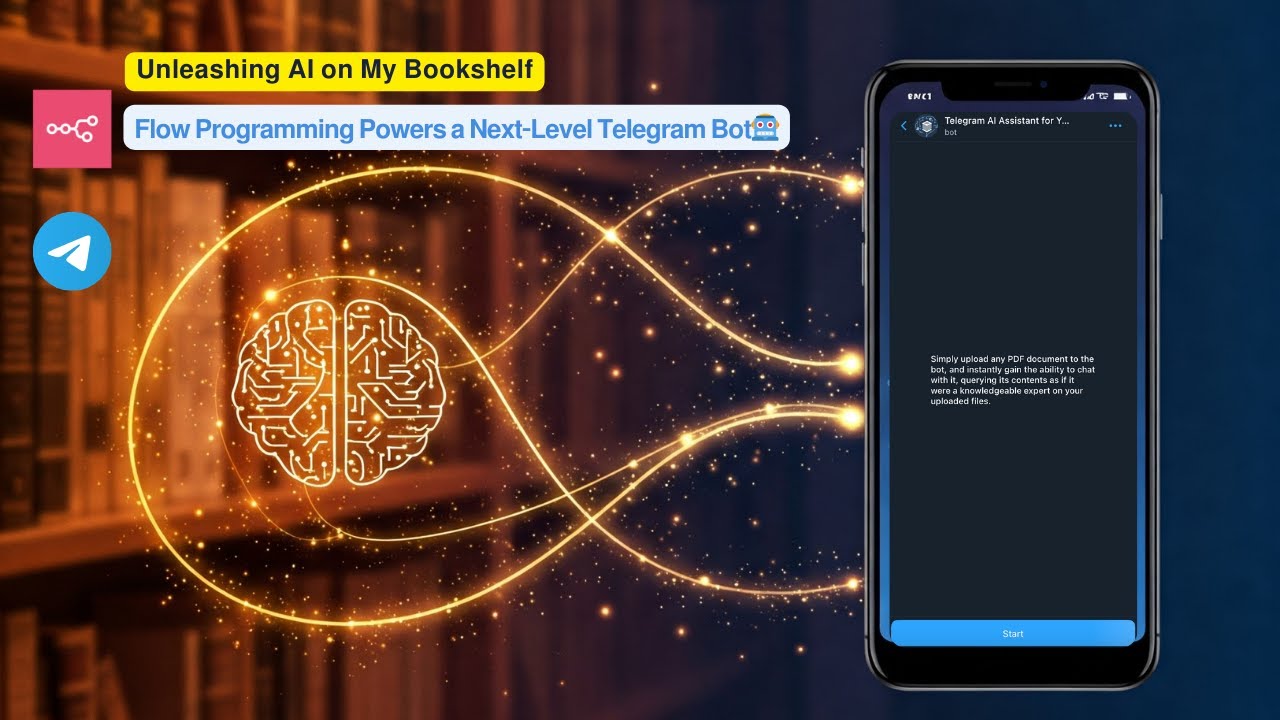
โถ๏ธ Click the image above to watch a live demo on YouTube.
This video provides a live demonstration of the bot's core features and how it interacts. See a quick walkthrough of its capabilities and user flow.
How it works:
User uploads a PDF document to a Telegram bot.
The workflow processes the PDF, creates embeddings using Google Gemini, and stores these embeddings in a Supabase vector table.
Users then ask questions to the bot.
The workflow performs a vector search in Supabase to find relevant document chunks based on the user's query.
Google Gemini uses the retrieved relevant chunks to generate an intelligent answer.
The bot sends the formatted answer back to the user on Telegram, utilizing HTML markup for enhanced presentation.
Set up steps:
Setup should take approximately 15-20 minutes.
Import the workflow into your n8n instance.
Configure credentials for Telegram, Google Gemini, and Supabase.
Set up your Supabase vector table using the provided SQL script.
Activate the workflow.
Detailed setup instructions, including how to get API keys and configure nodes, are available in the sticky notes within the workflow itself.
This catalog entry is organized from the workflow JSON. The node-level section below shows the executable blocks available for review before importing the template.
Showing the first 24 of 28 workflow blocks. Download the JSON for the full node graph.
| Workflow | Document Q&A chatbot with Gemini AI and Supabase vector search for Telegram |
|---|---|
| Complexity | advanced |
| Nodes | 28 |
| Categories | Personal Productivity, AI RAG |
| Author | Mohammad Ghaffarifar |
| Published | 08 May 2025 |
Use the JSON export at /data/workflows/3940/3940.json as the source template for this automation.
Open n8n, import the downloaded JSON, and review each node before activating the workflow.
Replace placeholder credentials, API keys, webhook URLs, account IDs, and environment-specific values with your own settings.
Run the workflow manually or in a staging workspace, inspect node output, and confirm downstream systems receive the expected data.
Enable the workflow only after testing, then monitor executions, errors, and rate limits during the first production runs.
Review imported nodes carefully before activation. This catalog entry is intended to help you inspect the workflow structure, understand required services, and find related templates faster.
Node names, credentials, schedules, webhook paths, and external service limits may need adjustment for your workspace.
This template creates a Telegram AI Assistant that answers questions based on your documents, powered by Google Gemini and Supabase. Key features include Intelligent HTML Post processing for rich f...
Review the workflow JSON, configure any required credentials in n8n, and test the automation in a safe workspace before using it in production.
Yes. Use the block-by-block analysis and the downloadable JSON to inspect each node, then adjust credentials, prompts, schedules, filters, or destinations for your Personal Productivity, AI RAG use case.