Detect human vs AI text using stylometric metrics and multi‐agent LLM debate
Workflow preview


 Early Deal
DISCOUNT 20%

Overview
Stop guessing if text came from ChatGPT. Let three AI agents argue about it using forensic data.
Paste any text and get a verdict on whether it was written by a human, AI, or a hybrid mix. Instead of trusting one black-box score, this workflow runs your text through statistical analysis and a three-agent debate where each agent challenges the others using hard numbers.
This is not another "detect AI with AI" template. The workflow measures six forensic markers first, then makes three separate agents argue about what those numbers mean. You see the raw data, the debate, and the final verdict with confidence scores.
How it works
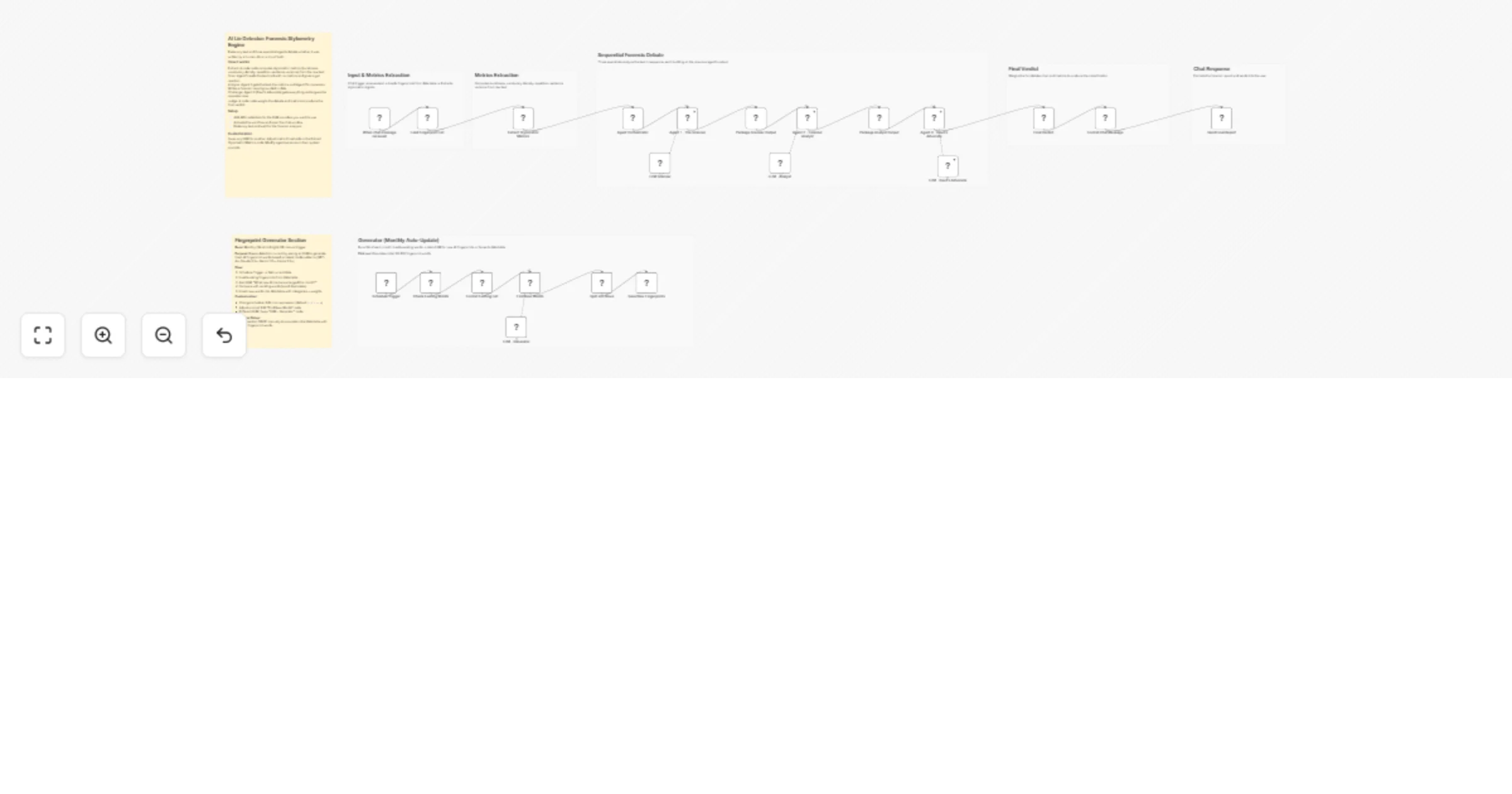
The workflow runs in five stages:
Extract forensic metrics: A code node measures burstiness (sentence length variation), type-token ratio (vocabulary diversity), hapax rate (words appearing once), repetition score (repeated phrases), transition density (filler words like "furthermore"), and AI fingerprints (100+ known LLM phrases stored in a data table). Short texts under 150 words get recalibrated because metrics are less reliable.
Agent 1 - The Scanner: Reads the text cold with zero metrics. Gives a gut impression (human/AI/hybrid) based purely on instinct. Acts like an editor who has read thousands of manuscripts.
Agent 2 - Forensic Analyst: Gets the text, all metrics, and Agent 1's verdict. Writes a data-driven report that must cite specific numbers. Either agrees or disagrees with Agent 1 and explains why using the forensic evidence.
Agent 3 - Devil's Advocate: Gets everything above and argues the opposite of whatever Agent 2 concluded. If Agent 2 said AI, Agent 3 must argue human. Finds holes in the logic and metrics that got ignored.
Weighted verdict: A code node scores all three agents (35% Analyst, 15% Scanner, 15% Devil's Advocate, 35% raw metrics) and classifies as human (score under 0.35), AI (score over 0.60), or AI-augmented (in between). Confidence is calculated separately so you get verdicts like "AI with 67% confidence."
Chat output format
The chat response shows:
- Verdict badge: 🙎🏻 Human-Written, 🤖 AI-Generated, or 🦾 AI-Augmented
- Confidence bar: Visual bar (██████████ 85%) showing how certain the verdict is
- Metrics table: All six forensic markers with 🟥 AI or 🟩 Human flags
- Agent debate: Three verdicts with reasoning. Agent 1's gut check, Agent 2's forensic report, Agent 3's counter-argument. Each shows classification and confidence percentage.
Example output for AI text:
🤖 Verdict: AI-Generated
Confidence: ████████░░ 87%

📊 Stylometric Metrics:
Burstiness: 0.18 🟥 AI
Vocabulary Diversity: 0.36 🟥 AI
Hapax Rate: 0.32 🟥 AI
Repetition: 0.21 🟥 AI
Transition Density: 0.024 🟥 AI

🔎 Agent 1 (Gut Check): AI (90%)
"Monotonous rhythm, corporate vocabulary, zero personality"

🔬 Agent 2 (Data): AI (95%)
"Five of six metrics flag AI. Burstiness of 0.18 well below human threshold..."

😈 Agent 3 (Critic): AI-AUGMENTED (65%)
"Could be human technical writing. Transition density alone not conclusive..."
Self-updating fingerprint database
A separate workflow branch runs weekly to keep the AI phrase list current:
- Check existing words: Reads all fingerprint phrases from the data table
- Find new AI tells: Asks an LLM what phrases modern models currently overuse
- Filter duplicates: Removes words already in the database
- Add to table: Stores new phrases for future detection
Requires: A data table (Google Sheets, Airtable, or n8n Data Table) to store fingerprint words. The workflow includes a starter list of 100+ phrases like "delve into," "it's worth noting," "as of my last update."
LLM writing patterns shift fast. What worked for GPT-3 detection does not work for GPT-4. This keeps the detector current without manual updates.
Key benefits
- Three classifications instead of binary. Human, AI, or AI-augmented. Most real content is hybrid.
- You see the reasoning. Full agent debate included. When verdicts are borderline, you can read which argument won.
- Transparent metrics. Raw numbers exposed with red/green flags. No hidden scoring.
- Self-updating detection. Weekly workflow finds new AI phrase patterns as models evolve.
- Error resilient. If one agent fails, the workflow continues and redistributes weights.
Who this is for
- Content teams verifying contractor submissions are not AI-generated
- Educators checking student essays for AI assistance
- Publishers screening submissions to maintain editorial standards
- SEO teams ensuring content meets Google's helpful content guidelines
- Researchers analyzing hybrid human-AI writing patterns
Setup
- Add API credentials for at least one LLM provider (Groq, OpenAI, Gemini, or Anthropic)
- Create a data table for AI fingerprint phrases or use n8n's built-in Data Table node
- Populate the table with the starter list (included in workflow documentation)
- Activate the workflow and open the chat interface
- Paste text and wait 30-60 seconds for forensic analysis
Required APIs & credentials
At least one LLM provider: OpenAI, Anthropic, Google Gemini, Groq, or any other provider with JSON output support. Each agent can use a different provider or all can use the same one.
Data storage for fingerprint phrases: n8n Data Table (built-in), Google Sheets, or Airtable. The workflow checks this table to identify known AI phrases during analysis.
How to customise it
- Swap models: Each agent node has a chat model sub-node. Replace with any provider. Scanner works with smaller models. Analyst needs strong reasoning. Devil's Advocate needs good instruction-following.
- Tune thresholds: Open Extract Stylometric Metrics code. Burstiness under 0.3 flags AI. Type-token ratio under 0.4 flags AI. Adjust for stricter or looser detection.
- Change agent weights: Open Final Verdict code. Default is 35% Analyst, 15% Scanner, 15% Devil's Advocate, 35% metrics. Increase metric weight to trust data more.
- Modify agent personas: Edit system prompts. Make Scanner more skeptical. Make Analyst cite sources. Make Devil's Advocate more aggressive.
- Add quality gate: Drop a Filter node after verdict. Only proceed if confidence exceeds 70%.
- Batch process: Replace Chat Trigger with Schedule Trigger looping over a file list.
Known limitations
The workflow works best on long-form content (500+ words). Short texts under 100 words produce less reliable metrics because statistical patterns need more data to emerge. The recalibration helps but is not perfect.
AI fingerprint phrases evolve as models improve. GPT-5 might not use "delve into" but will have new tells. The self-updating workflow helps but lags current releases by a few weeks.
The three-agent debate architecture assumes disagreement is meaningful. For extremely niche topics where only one agent has relevant training data, the minority opinion might be correct but gets outvoted. Review the individual agent reasoning when dealing with specialized content.