
Create RAG vector database from Google Drive documents using Gemini & Supabase

Workflow preview
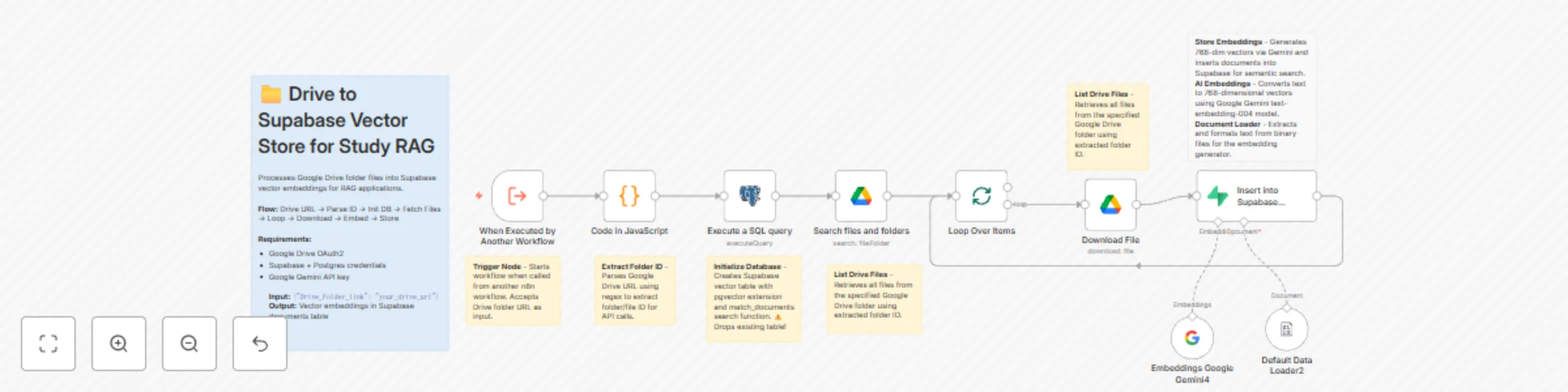
Workflow preview
100%
Create RAG vector database from Google Drive documents using Gemini & Supabase preview
Open on n8n.io

Important notice

This workflow is provided as-is. Please review and test before using in production.

1. Workflow Overview

How it works This workflow automates the process of converting Google Drive documents into searchable vector embeddings for AI powered applications: • Takes a Google Drive folder URL as input • Ini...

Best for

  • Document Extraction automation workflows
  • AI RAG automation workflows
  • advanced n8n builders looking for reusable templates

Tools used

@n8n/n8n-nodes-langchain.embeddingsgooglegemini, @n8n/n8n-nodes-langchain.documentdefaultdataloader, n8n-nodes-base.postgres, n8n-nodes-base.code, n8n-nodes-base.executeworkflowtrigger, n8n-nodes-base.stickynote, n8n-nodes-base.splitinbatches, n8n-nodes-base.googledrive

Source and attribution

This workflow is cataloged by N8N Workflows and links back to its original n8n.io source page by Mantaka Mahir.

Original n8n.io source

1.1 Workflow description

Title
Create RAG vector database from Google Drive documents using Gemini & Supabase
Workflow name
Create RAG vector database from Google Drive documents using Gemini & Supabase

How it works

This workflow automates the process of converting Google Drive documents into searchable vector embeddings for AI-powered applications:

• Takes a Google Drive folder URL as input • Initializes a Supabase vector database with pgvector extension • Fetches all files from the specified Drive folder • Downloads and converts each file to plain text • Generates 768-dimensional embeddings using Google Gemini • Stores documents with embeddings in Supabase for semantic search

Built for the Study Agent workflow to power document-based Q&A, but also works perfectly for any RAG system, AI chatbot, knowledge base, or semantic search application that needs to query document collections.

Set up steps

Prerequisites: • Google Drive OAuth2 credentials • Supabase account with Postgres connection details • Google Gemini API key (free tier available)

Setup time: ~10 minutes

Steps:

  1. Add your Google Drive OAuth2 credentials to the Google Drive nodes
  2. Configure Supabase Postgres credentials in the SQL node
  3. Add Supabase API credentials to the Vector Store node
  4. Add Google Gemini API key to the Embeddings node
  5. Update the input with your Drive folder URL
  6. Execute the workflow

Note: The SQL query will drop any existing "documents" table, so backup data if needed. Detailed node-by-node instructions are in the sticky notes within the workflow.

Works with: Study Agent (main use case), custom AI agents, chatbots, documentation search, customer support bots, or any RAG application.

1.2 Logical Blocks

This catalog entry is organized from the workflow JSON. The node-level section below shows the executable blocks available for review before importing the template.

2. Block-by-Block Analysis

Block 1 - Embeddings Google Gemini4

Type / Role
@n8n/n8n-nodes-langchain.embeddingsGoogleGemini - embeddingsGoogleGemini
Config choices
Version 1

Block 2 - Default Data Loader2

Type / Role
@n8n/n8n-nodes-langchain.documentDefaultDataLoader - documentDefaultDataLoader
Config choices
Version 1.1

Block 3 - Execute a SQL query

Type / Role
n8n-nodes-base.postgres - postgres
Config choices
Version 2.6

Block 4 - Code in JavaScript

Type / Role
n8n-nodes-base.code - code
Config choices
Version 2

Block 5 - When Executed by Another Workflow

Type / Role
n8n-nodes-base.executeWorkflowTrigger - executeWorkflowTrigger
Config choices
Version 1.1

Block 6 - Sticky Note1

Type / Role
n8n-nodes-base.stickyNote - stickyNote
Config choices
Version 1

Block 7 - Sticky Note

Type / Role
n8n-nodes-base.stickyNote - stickyNote
Config choices
Version 1

Block 8 - Sticky Note2

Type / Role
n8n-nodes-base.stickyNote - stickyNote
Config choices
Version 1

Block 9 - Sticky Note3

Type / Role
n8n-nodes-base.stickyNote - stickyNote
Config choices
Version 1

Block 10 - Loop Over Items

Type / Role
n8n-nodes-base.splitInBatches - splitInBatches
Config choices
Version 3

Block 11 - Search files and folders

Type / Role
n8n-nodes-base.googleDrive - googleDrive
Config choices
Version 3

Block 12 - Insert into Supabase Vectorstore

Type / Role
@n8n/n8n-nodes-langchain.vectorStoreSupabase - vectorStoreSupabase
Config choices
Version 1

Block 13 - Download File

Type / Role
n8n-nodes-base.googleDrive - googleDrive
Config choices
Version 3

Block 14 - Sticky Note4

Type / Role
n8n-nodes-base.stickyNote - stickyNote
Config choices
Version 1

Block 15 - Sticky Note5

Type / Role
n8n-nodes-base.stickyNote - stickyNote
Config choices
Version 1

Block 16 - Sticky Note6

Type / Role
n8n-nodes-base.stickyNote - stickyNote
Config choices
Version 1

3. Summary Table

Workflow Create RAG vector database from Google Drive documents using Gemini & Supabase
Complexity advanced
Nodes 16
Categories Document Extraction, AI RAG
Author Mantaka Mahir
Published 09 Nov 2025

4. Reproducing the Workflow from Scratch

  1. 1. Download the workflow JSON

    Use the JSON export at /data/workflows/10651/10651.json as the source template for this automation.

  2. 2. Import the template into n8n

    Open n8n, import the downloaded JSON, and review each node before activating the workflow.

  3. 3. Configure credentials and variables

    Replace placeholder credentials, API keys, webhook URLs, account IDs, and environment-specific values with your own settings.

  4. 4. Test with sample data

    Run the workflow manually or in a staging workspace, inspect node output, and confirm downstream systems receive the expected data.

  5. 5. Activate and monitor

    Enable the workflow only after testing, then monitor executions, errors, and rate limits during the first production runs.

5. General Notes & Resources

Review imported nodes carefully before activation. This catalog entry is intended to help you inspect the workflow structure, understand required services, and find related templates faster.

Node names, credentials, schedules, webhook paths, and external service limits may need adjustment for your workspace.

Frequently asked questions

What does Create RAG vector database from Google Drive documents using Gemini & Supabase do?

How it works This workflow automates the process of converting Google Drive documents into searchable vector embeddings for AI powered applications: • Takes a Google Drive folder URL as input • Ini...

What do I need before importing this workflow?

Review the workflow JSON, configure any required credentials in n8n, and test the automation in a safe workspace before using it in production.

Can I customize this workflow?

Yes. Use the block-by-block analysis and the downloadable JSON to inspect each node, then adjust credentials, prompts, schedules, filters, or destinations for your Document Extraction, AI RAG use case.



