
Create multi-sheet Excel workbooks by merging datasets with Google Drive & Sheets

Workflow preview
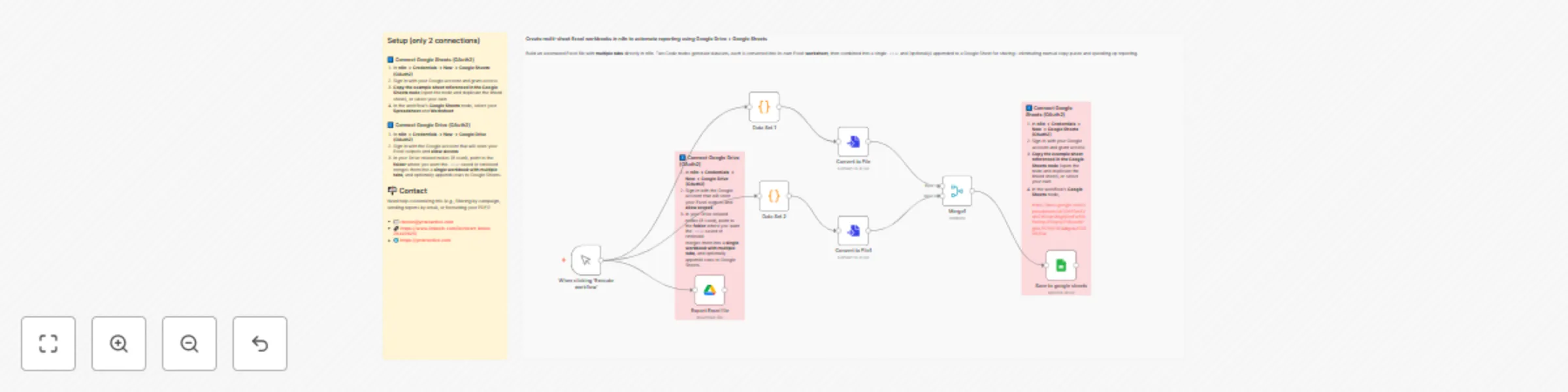
Workflow preview
100%
Create multi-sheet Excel workbooks by merging datasets with Google Drive & Sheets preview
Open on n8n.io

Important notice

This workflow is provided as-is. Please review and test before using in production.

1. Workflow Overview

Create multi sheet Excel workbooks in n8n to automate reporting using Google Drive + Google Sheets Build an automated Excel file with multiple tabs directly in n8n. Two Code nodes generate datasets...

Best for

  • Document Extraction automation workflows
  • Multimodal AI automation workflows
  • intermediate n8n builders looking for reusable templates

Tools used

n8n-nodes-base.manualtrigger, n8n-nodes-base.converttofile, n8n-nodes-base.merge, n8n-nodes-base.stickynote, n8n-nodes-base.code, n8n-nodes-base.googlesheets, n8n-nodes-base.googledrive

Source and attribution

This workflow is cataloged by N8N Workflows and links back to its original n8n.io source page by Robert Breen.

Original n8n.io source

1.1 Workflow description

Title
Create multi-sheet Excel workbooks by merging datasets with Google Drive & Sheets
Workflow name
Create multi-sheet Excel workbooks by merging datasets with Google Drive & Sheets

Create multi-sheet Excel workbooks in n8n to automate reporting using Google Drive + Google Sheets

Build an automated Excel file with multiple tabs directly in n8n. Two Code nodes generate datasets, each is converted into its own Excel worksheet, then combined into a single .xlsx and (optionally) appended to a Google Sheet for sharing—eliminating manual copy-paste and speeding up reporting.

Who’s it for

  • Teams that publish recurring reports as Excel with multiple tabs
  • Ops/Marketing/Data folks who want a no-code/low-code way to package JSON into Excel
  • n8n beginners learning the Code → Convert to File → Merge pattern

How it works

  1. Manual Trigger starts the run.
  2. Code nodes emit JSON rows for each table (e.g., People, Locations).
  3. Convert to File nodes turn each JSON list into an Excel binary, assigning Sheet1/Sheet2 (or your names).
  4. Merge combines both binaries into a single Excel workbook with multiple tabs.
  5. Google Sheets (optional) appends the JSON rows to a live spreadsheet for collaboration.

Setup (only 2 connections)

1️⃣ Connect Google Sheets (OAuth2)

  1. In n8n → Credentials → New → Google Sheets (OAuth2)
  2. Sign in with your Google account and grant access
  3. Copy the example sheet referenced in the Google Sheets node (open the node and duplicate the linked sheet), or select your own
  4. In the workflow’s Google Sheets node, select your Spreadsheet and Worksheet

https://docs.google.com/spreadsheets/d/1G6FSm3VdMZt6VubM6g8j0mFw59iEw9npJE0upxj3Y6k/edit?gid=1978181834#gid=1978181834

2️⃣ Connect Google Drive (OAuth2)

  1. In n8n → Credentials → New → Google Drive (OAuth2)
  2. Sign in with the Google account that will store your Excel outputs and allow access
  3. In your Drive-related nodes (if used), point to the folder where you want the .xlsx saved or retrieved

Customize the workflow

  • Replace the sample arrays in the Code nodes with your data (APIs, DBs, CSVs, etc.)
  • Rename sheetName in each Convert to File node to match your desired tab names
  • Keep the Merge node in Combine All mode to produce a single workbook
  • In Google Sheets, switch to Manual mapping for strict column order (optional)

Best practices (per template guidelines)

  • Rename nodes to clear, action-oriented names (e.g., “Build People Sheet”, “Build Locations Sheet”)
  • Add a yellow Sticky Note at the top with this description so users see setup in-workflow
  • Do not hardcode credentials inside HTTP nodes; always use n8n Credentials
  • Remove personal IDs/links before publishing

Sticky Note (copy-paste)

> Multi-Tab Excel Builder (Google Drive + Google Sheets)
> This workflow generates two datasets (Code → JSON), converts each to an Excel sheet, merges them into a single workbook with multiple tabs, and optionally appends rows to Google Sheets.
>
> Setup (2 connections):
> 1) Google Sheets (OAuth2): Create credentials → duplicate/select your target spreadsheet → set Spreadsheet + Worksheet in the node.
> 2) Google Drive (OAuth2): Create credentials → choose the folder for storing/retrieving the .xlsx.
>
> Customize: Edit the Code nodes’ arrays, rename tab names in Convert to File, and adjust the Sheets node mapping as needed.

Troubleshooting

  • Missing columns / wrong order: Use Manual mapping in the Google Sheets node
  • Binary not found: Ensure each Convert to File node’s binaryPropertyName matches what Merge expects
  • Permissions errors: Re-authorize Google credentials; confirm you have edit access to the target Sheet/Drive folder

📬 Contact

Need help customizing this (e.g., filtering by campaign, sending reports by email, or formatting your PDF)?

1.2 Logical Blocks

This catalog entry is organized from the workflow JSON. The node-level section below shows the executable blocks available for review before importing the template.

2. Block-by-Block Analysis

Block 1 - When clicking ‘Execute workflow’

Type / Role
n8n-nodes-base.manualTrigger - manualTrigger
Config choices
Version 1

Block 2 - Convert to File

Type / Role
n8n-nodes-base.convertToFile - convertToFile
Config choices
Version 1.1

Block 3 - Convert to File1

Type / Role
n8n-nodes-base.convertToFile - convertToFile
Config choices
Version 1.1

Block 4 - Merge1

Type / Role
n8n-nodes-base.merge - merge
Config choices
Version 3.2

Block 5 - Sticky Note60

Type / Role
n8n-nodes-base.stickyNote - stickyNote
Config choices
Version 1

Block 6 - Sticky Note62

Type / Role
n8n-nodes-base.stickyNote - stickyNote
Config choices
Version 1

Block 7 - Sticky Note54

Type / Role
n8n-nodes-base.stickyNote - stickyNote
Config choices
Version 1

Block 8 - Sticky Note2

Type / Role
n8n-nodes-base.stickyNote - stickyNote
Config choices
Version 1

Block 9 - Data Set 1

Type / Role
n8n-nodes-base.code - code
Config choices
Version 2

Block 10 - Data Set 2

Type / Role
n8n-nodes-base.code - code
Config choices
Version 2

Block 11 - Save to google sheets

Type / Role
n8n-nodes-base.googleSheets - googleSheets
Config choices
Version 4.7

Block 12 - Export Excel file

Type / Role
n8n-nodes-base.googleDrive - googleDrive
Config choices
Version 3

3. Summary Table

Workflow Create multi-sheet Excel workbooks by merging datasets with Google Drive & Sheets
Complexity intermediate
Nodes 12
Categories Document Extraction, Multimodal AI
Author Robert Breen
Published 27 Aug 2025

4. Reproducing the Workflow from Scratch

  1. 1. Download the workflow JSON

    Use the JSON export at /data/workflows/7955/7955.json as the source template for this automation.

  2. 2. Import the template into n8n

    Open n8n, import the downloaded JSON, and review each node before activating the workflow.

  3. 3. Configure credentials and variables

    Replace placeholder credentials, API keys, webhook URLs, account IDs, and environment-specific values with your own settings.

  4. 4. Test with sample data

    Run the workflow manually or in a staging workspace, inspect node output, and confirm downstream systems receive the expected data.

  5. 5. Activate and monitor

    Enable the workflow only after testing, then monitor executions, errors, and rate limits during the first production runs.

5. General Notes & Resources

Review imported nodes carefully before activation. This catalog entry is intended to help you inspect the workflow structure, understand required services, and find related templates faster.

Node names, credentials, schedules, webhook paths, and external service limits may need adjustment for your workspace.

Frequently asked questions

What does Create multi-sheet Excel workbooks by merging datasets with Google Drive & Sheets do?

Create multi sheet Excel workbooks in n8n to automate reporting using Google Drive + Google Sheets Build an automated Excel file with multiple tabs directly in n8n. Two Code nodes generate datasets...

What do I need before importing this workflow?

Review the workflow JSON, configure any required credentials in n8n, and test the automation in a safe workspace before using it in production.

Can I customize this workflow?

Yes. Use the block-by-block analysis and the downloadable JSON to inspect each node, then adjust credentials, prompts, schedules, filters, or destinations for your Document Extraction, Multimodal AI use case.



