Create LinkedIn content with GPT-4 via Telegram bot & approval loop
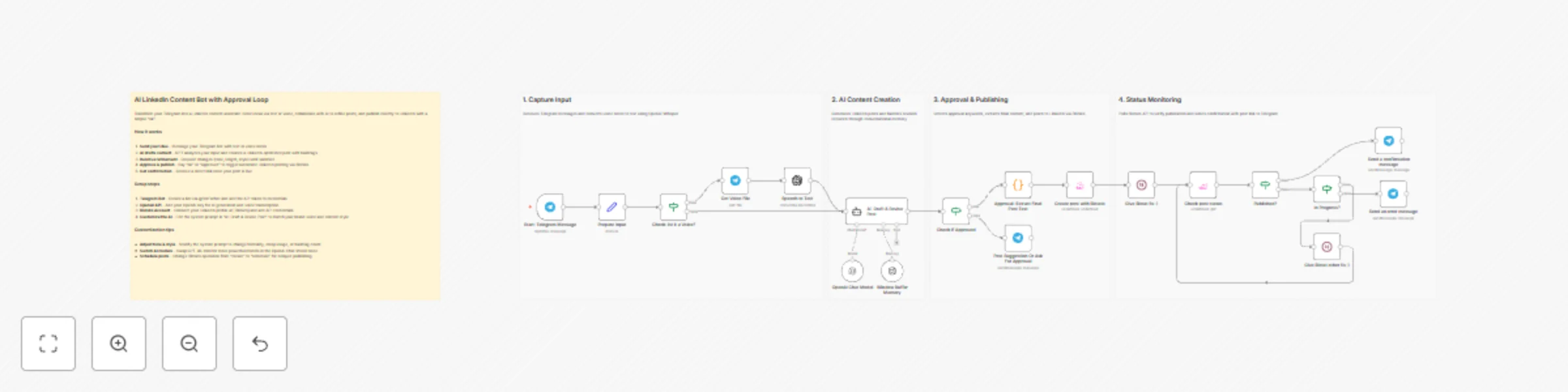
Workflow preview


 Early Deal
DISCOUNT 20%

Important notice
This workflow is provided as-is. Please review and test before using in production.
Overview
AI LinkedIn Content Bot with Approval Loop
This n8n workflow transforms your Telegram messenger into a personal assistant for creating and publishing LinkedIn posts. You can simply send an idea as a text or voice message, collaboratively edit the AI's suggestion in a chat, and then publish the finished post directly to LinkedIn just by saying "Okay."
What You'll Need to Get Started
Before you can use this workflow, you'll need a few prerequisites set up. This workflow connects three different services, so you will need API credentials for each:
Telegram Bot API Key: You can get this by talking to the "BotFather" on Telegram. It will guide you through creating your new bot and provide you with the API token. New Chat with Telegram BotFather
OpenAI API Key: This is required for the "Speech to Text" and "AI Agent" nodes. You'll need an account with OpenAI to generate this key. OpenAI API Platform
Blotato API Key: This service is used to publish the final post to LinkedIn. You'll need a Blotato account and to connect your LinkedIn profile there to get the key. [Blotato platform for social media publishing]
Once you have these keys, you can add them to the corresponding credentials in your n8n instance.
How the Workflow Operates, Step-by-Step
Here is a detailed breakdown of how the workflow processes your request and handles the publishing.
1. Input & Initial Processing
This phase captures your idea and converts it into usable text.
| Node Name | Role in Workflow |
|---|---|
Start: Telegram Message |
This Telegram Trigger node initiates the entire process upon receiving any message from you in the bot. |
Prepare Input |
Consolidates the message content, ensuring the AI receives only one clean text input. |
Check: ist it a Voice? |
Checks the incoming message for text. If text is empty, it proceeds to voice handling. |
Get Voice File |
If a voice note is detected, this node downloads the raw audio file from Telegram. |
Speech to Text |
This node uses the OpenAI Whisper API to convert the downloaded audio file into a text string. |
2. AI Core & Iteration Loop
This is the central dialogue system where the AI drafts the content and engages in the feedback loop.
| Node Name | Role in Workflow |
|---|---|
AI: Draft & Revise Post |
The main logic agent. It analyzes your request, applies the "System Prompt" rules, drafts the post, and handles revisions based on your feedback. |
OpenAI Chat Model |
Defines the large language model (LLM) used for generating and revising the post. |
Window Buffer Memory |
A memory buffer that stores the last turns of the conversation, allowing the AI to maintain context when you request changes (e.g., "Make it shorter"). |
Check if Approved |
This crucial node detects the specific JSON structure the AI outputs only when you provide an approval keyword (like "ok" or "approved"). |
Post Suggestion Or Ask For Approval |
Sends the AI's post draft back to your Telegram chat for review and feedback. |
AI Agent System Prompt (Internal Instructions - English)
The agent operates under a strict prompt that dictates its behavior and formatting (found within the AI: Draft & Revise Post node):
> You are a LinkedIn Content Creator Agent for Telegram.
> Keep the confirmation process, but change the output format as follows:
>
> Your Task
> Analyze the user's message:
>
> * Topic
> * Goal (e.g., reach, show expertise, recruiting, personal branding, leads)
> * Target Audience
> * Tonality (e.g., factual, personal, bold, inspiring)
>
> Create a LinkedIn post as ONE continuous text:
>
> * Strong hook in the first 1–2 lines.
> * Clear main part with added value, story, example, or insight.
> * Optional Call-to-Action (e.g., question to the community, invitation to exchange).
> * Integrate hashtags at the end of the post (5–12 suitable hashtags, mix of niche + somewhat broader).
> * Readable on LinkedIn: short paragraphs, emojis only sparingly.
>
> Present the suggestion to the user in the following format:
>
> Headline: Post Proposal:
> Below that, the complete LinkedIn post (incl. hashtags at the end in the same text).
>
> Ask for feedback:
> For example:
> "Any changes? (Tone, length, formality, personal vs. professional, more technical content, different hashtags?)"
>
> If the user requests changes:
> Adjust the post specifically based on the feedback.
> Again, output only:
> Post Proposal:
> the revised complete post.
>
> If the user says “approved”, “ok”, “sounds good”, or similar:
> Return exclusively this JSON, without additional text, without Markdown:
>
> json > { > "Post": "The final LinkedIn post as one text, including hashtags at the end" > } >
>
> Important:
>
> * Never output JSON before approval, only normal suggestion text.
> * The final output after approval consists of only one field: Post.
3. Publishing & Status Check
Once approved, the workflow handles the publication and monitors the post's status in real-time.
| Node Name | Role in Workflow |
|---|---|
Approval: Extract Final Post Text |
Parses the incoming JSON, extracting only the clean text ready for publishing. |
Create post with Blotato |
Uses the Blotato API to upload the finalized content to your connected LinkedIn account. |
Give Blotat 5s :) |
A brief pause to allow the publishing service to start processing the request. |
Check post status |
Checks back with Blotato to determine if the post is published, in progress, or failed. |
Published? |
Checks if the status is "published" to send the success message. |
In Progress? |
Checks if the post is still being processed. If so, it loops back to the next wait period. |
Give Blotat other 5s :) |
Pauses the workflow before re-checking the post status, preventing unnecessary API calls. |
4. Final Notification
| Node Name | Role in Workflow |
|---|---|
Send a confirmation message |
Sends a confirmation message and the direct link to the published LinkedIn post. |
Send an error message |
Sends a notification if the post failed to upload or encountered an error during processing. |
🛠️ Personalizing Your Content Bot
The true power of this n8n workflow lies in its flexibility. You can easily modify key components to match your unique brand voice and technical preferences.
1. Tweak the Content Creator Prompt
The personality, tone, and formatting rules for your LinkedIn content are all defined in the System Prompt.
- Where to find it: Inside the
AI: Draft & Revise Postnode, under theSystem Messagesetting. - What to personalize: Adjust the tone, change the formatting rules (e.g., number of hashtags, required emojis), or insert specific details about your industry or target audience.
2. Switch the AI Model or Provider
You can easily swap the language model used for generation.
- Where to find it: The
OpenAI Chat Modelnode. - What to personalize:
- Model: Swap out the default model for a more powerful or faster alternative (e.g.,
gpt-4family, or models from other providers if you change the node). - Provider: You can replace the entire Langchain block (including the
AI ModelandWindow Buffer Memorynodes) with an equivalent block using a different provider's Chat/LLM node (e.g., Anthropic, Cohere, or Google Gemini), provided you set up the corresponding credentials and context flow.
- Model: Swap out the default model for a more powerful or faster alternative (e.g.,
3. Modify Publishing Behavior (Schedule vs. Post)
The final step is currently set to publish immediately, but you might prefer to schedule posts.
- Where to find it: The
Create post with Blotatonode. - What to personalize:
- Consult the Blotato documentation for alternative operations. Instead of choosing the "Create Post" operation (which often posts immediately), you can typically select a "Schedule Post" or "Add to Queue" operation within the Blotato node.
- If scheduling, you will need to add a step (e.g., a Set node or another agent prompt) before publishing to calculate and pass a
Scheduled Timeparameter to the Blotato node.