Create Dynamic Workflows Programmatically via Webhooks & n8n API
Workflow preview

$20/month : Unlimited workflows
2500 executions/month

THE #1 IN WEB SCRAPING
Scrape any website without limits
HOSTINGER  Early Deal
DISCOUNT 20% Try free
Early DealDISCOUNT 20%
Self-hosted n8n
Unlimited workflows - from $4.99/mo

#1 hub for scraping, AI & automation
6000+ actors - $5 credits/mo
Important notice
This workflow is provided as-is. Please review and test before using in production.
Overview
Overview
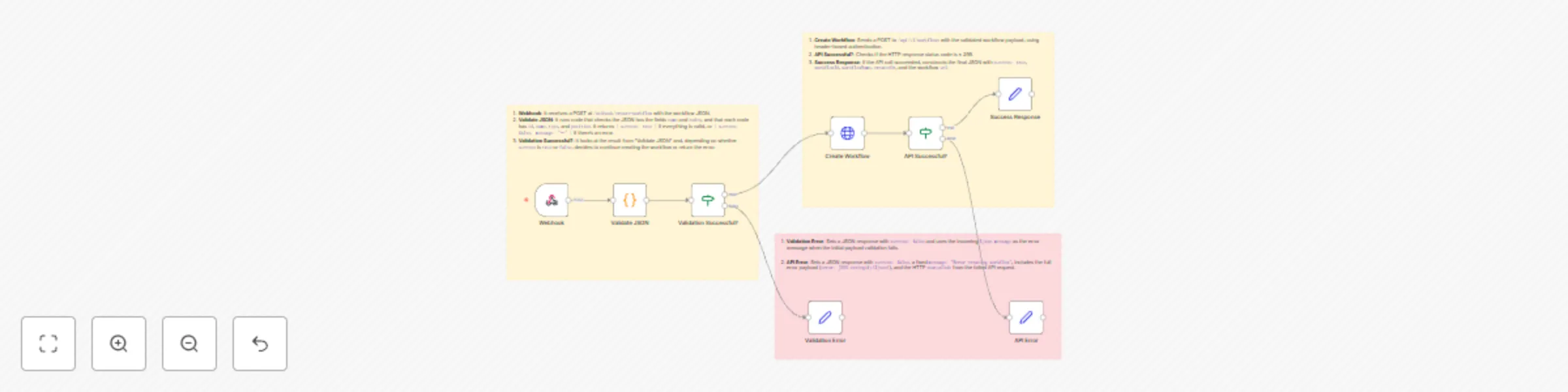
This workflow exposes an HTTP endpoint (webhook) that accepts a JSON definition of an n8n workflow, validates it, and—if everything is correct—dynamically creates that workflow in the n8n instance via its internal API. If any validation fails or the API call encounters an error, an explanatory message with details is returned.
Workflow Diagram
Webhook
   │
   ▼
Validate JSON ── fails validation ──► Validation Error
   │
   └─ passes ─► Validation Successful?
                           │
                           ├─ true ─► Create Workflow ──► API Successful? ──► Success Response
                           │                                 │
                           │                                 └─ false ─► API Error
                           └─ false ─► Validation Error
Step-by-Step Details
1. Webhook
- Type: Webhook (POST)
- Path:
/webhook/create-workflow - Purpose: Expose a URL to receive a JSON definition of a workflow.
- Expected Input: JSON containing the main workflow fields (
name,nodes,connections,settings).
2. Validate JSON
Type: Code Node (JavaScript)
Validations Performed:
- Ensure that
payloadexists and contains bothnameandnodes. - Verify that
nodesis an array with at least one item. - Check that each node includes the required fields:
id,name,type,position. - If missing, initialize
connections,settings,parameters, andtypeVersion.
- Ensure that
Output if Error:
{ "success": false, "message": "<error description>" }Output if Valid:
{
  "success": true,
  "apiWorkflow": {
    "name": payload.name,
    "nodes": payload.nodes,
    "connections": payload.connections,
    "settings": payload.settings
  }
}
3. Validation Successful?
Type: IF Node
Condition:
$json.success === trueBranches:
- true: proceed to Create Workflow
- false: route to Validation Error
4. Create Workflow
- Type: HTTP Request (POST)
- URL:
http://127.0.0.1:5678/api/v1/workflows - Authentication: Header Auth with internal credentials
- Body: The
apiWorkflowobject generated earlier - Options:
continueOnFail: true(to handle failures in the next IF)
5. API Successful?
Type: IF Node
Condition:
$response.statusCode <= 299Branches:
- true: proceed to Success Response
- false: route to API Error
6. Success Response
Type: SET Node
Output:
{
  "success": "true",
  "message": "Workflow created successfully",
  "workflowId": "{{ $json.data[0].id }}",
  "workflowName": "{{ $json.data[0].name }}",
  "createdAt": "{{ $json.data[0].createdAt }}",
  "url": "http://localhost:5678/workflow/{{ $json.data[0].id }}"
}
7. API Error
Type: SET Node
Output:
{
  "success": "false",
  "message": "Error creating workflow",
  "error": "{{ JSON.stringify($json) }}",
  "statusCode": "{{ $response.statusCode }}"
}
8. Validation Error
Type: SET Node
Output:
{ "success": false, "message": "{{ $json.message }}" }
Example Webhook Request
curl --location --request POST 'http://localhost:5678/webhook/create-workflow' \
--header 'Content-Type: application/json' \
--data-raw '{
  "name": "My Dynamic Workflow",
  "nodes": [
    {
      "id": "start-node",
      "name": "Start",
      "type": "n8n-nodes-base.manualTrigger",
      "typeVersion": 1,
      "position": [100, 100],
      "parameters": {}
    },
    {
      "id": "set-node",
      "name": "Set",
      "type": "n8n-nodes-base.set",
      "typeVersion": 1,
      "position": [300, 100],
      "parameters": {
        "values": {
          "string": [
            { "name": "message", "value": "Hello from a webhook-created workflow!" }
          ]
        }
      }
    }
  ],
  "connections": {
    "Start": {
      "main": [
        [ { "node": "Set", "type": "main", "index": 0 } ]
      ]
    }
  },
  "settings": {}
}'
Expected Success Response
{
  "success": "true",
  "message": "Workflow created successfully",
  "workflowId": "abcdef1234567890",
  "workflowName": "My Dynamic Workflow",
  "createdAt": "2025-05-31T12:34:56.789Z",
  "url": "http://localhost:5678/workflow/abcdef1234567890"
}
Validation Error Response
{
  "success": false,
  "message": "The 'name' field is required in the workflow"
}
API Error Response
{
  "success": "false",
  "message": "Error creating workflow",
  "error": "{ ...full API response details... }",
  "statusCode": 401
}