
Compare local Ollama Vision models for image analysis using Google Docs

Workflow preview
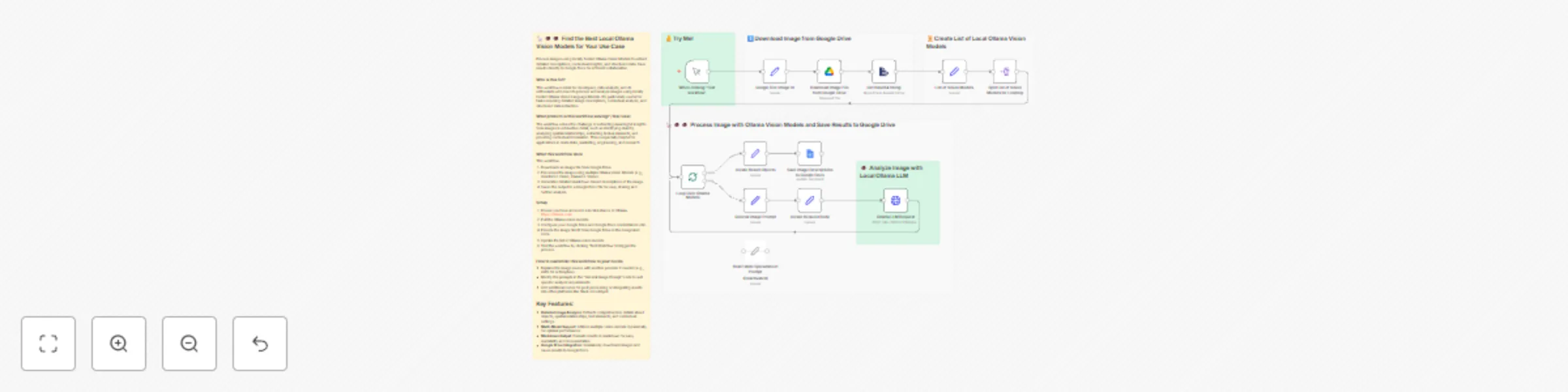
Workflow preview
100%
Compare local Ollama Vision models for image analysis using Google Docs preview
Open on n8n.io

Important notice

This workflow is provided as-is. Please review and test before using in production.

1. Workflow Overview

Compare Local Ollama Vision Models for Image Analysis using Google Docs Process images using locally hosted Ollama Vision Models to extract detailed descriptions, contextual insights, and structure...

Best for

  • Document Extraction automation workflows
  • Multimodal AI automation workflows
  • advanced n8n builders looking for reusable templates

Tools used

n8n-nodes-base.stickynote, n8n-nodes-base.manualtrigger, n8n-nodes-base.httprequest, n8n-nodes-base.set, n8n-nodes-base.splitinbatches, n8n-nodes-base.extractfromfile, n8n-nodes-base.googledrive, n8n-nodes-base.splitout

Source and attribution

This workflow is cataloged by N8N Workflows and links back to its original n8n.io source page by Joseph LePage.

Original n8n.io source

1.1 Workflow description

Title
Compare local Ollama Vision models for image analysis using Google Docs
Workflow name
Compare local Ollama Vision models for image analysis using Google Docs

Compare Local Ollama Vision Models for Image Analysis using Google Docs

Process images using locally hosted Ollama Vision Models to extract detailed descriptions, contextual insights, and structured data. Save results directly to Google Docs for efficient collaboration.

Who is this for?

This workflow is ideal for developers, data analysts, marketers and AI enthusiasts who need to process and analyze images using locally hosted Ollama Vision Language Models. It’s particularly useful for tasks requiring detailed image descriptions, contextual analysis, and structured data extraction.

What problem is this workflow solving? / Use Case

The workflow solves the challenge of extracting meaningful insights from images in exhaustive detail, such as identifying objects, analyzing spatial relationships, extracting textual elements, and providing contextual information. This is especially helpful for applications in real estate, marketing, engineering, and research.

What this workflow does

This workflow:

  1. Downloads an image file from Google Drive.
  2. Processes the image using multiple Ollama Vision Models (e.g., Granite3.2-Vision, Gemma3, Llama3.2-Vision).
  3. Generates detailed markdown-based descriptions of the image.
  4. Saves the output to a Google Docs file for easy sharing and further analysis.

Setup

  1. Ensure you have access to a local instance of Ollama. https://ollama.com/
  2. Pull the Ollama vision models.
  3. Configure your Google Drive and Google Docs credentials in n8n.
  4. Provide the image file ID from Google Drive in the designated node.
  5. Update the list of Ollama vision models
  6. Test the workflow by clicking ‘Test Workflow’ to trigger the process.

How to customize this workflow to your needs

  • Replace the image source with another provider if needed (e.g., AWS S3 or Dropbox).
  • Modify the prompts in the "General Image Prompt" node to suit specific analysis requirements.
  • Add additional nodes for post-processing or integrating results into other platforms like Slack or HubSpot.

Key Features:

  • Detailed Image Analysis: Extracts comprehensive details about objects, spatial relationships, text elements, and contextual settings.
  • Multi-Model Support: Utilizes multiple vision models dynamically for optimal performance.
  • Markdown Output: Formats results in markdown for easy readability and documentation.
  • Google Drive Integration: Seamlessly downloads images and saves results to Google Docs.

1.2 Logical Blocks

This catalog entry is organized from the workflow JSON. The node-level section below shows the executable blocks available for review before importing the template.

2. Block-by-Block Analysis

Block 1 - Sticky Note1

Type / Role
n8n-nodes-base.stickyNote - stickyNote
Config choices
Version 1

Block 2 - Sticky Note2

Type / Role
n8n-nodes-base.stickyNote - stickyNote
Config choices
Version 1

Block 3 - When clicking ‘Test workflow’

Type / Role
n8n-nodes-base.manualTrigger - manualTrigger
Config choices
Version 1

Block 4 - Ollama LLM Request

Type / Role
n8n-nodes-base.httpRequest - httpRequest
Config choices
Version 4.2

Block 5 - Create Request Body

Type / Role
n8n-nodes-base.set - set
Config choices
Version 3.4

Block 6 - Loop Over Ollama Models

Type / Role
n8n-nodes-base.splitInBatches - splitInBatches
Config choices
Version 3

Block 7 - Create Result Objects

Type / Role
n8n-nodes-base.set - set
Config choices
Version 3.4

Block 8 - General Image Prompt

Type / Role
n8n-nodes-base.set - set
Config choices
Version 3.4

Block 9 - Real Estate Spreadsheet Prompt

Type / Role
n8n-nodes-base.set - set
Config choices
Version 3.4

Block 10 - List of Vision Models

Type / Role
n8n-nodes-base.set - set
Config choices
Version 3.4

Block 11 - Get Base64 String

Type / Role
n8n-nodes-base.extractFromFile - extractFromFile
Config choices
Version 1

Block 12 - Download Image File from Google Drive

Type / Role
n8n-nodes-base.googleDrive - googleDrive
Config choices
Version 3

Block 13 - Split List of Vision Models for Looping

Type / Role
n8n-nodes-base.splitOut - splitOut
Config choices
Version 1

Block 14 - Sticky Note

Type / Role
n8n-nodes-base.stickyNote - stickyNote
Config choices
Version 1

Block 15 - Sticky Note3

Type / Role
n8n-nodes-base.stickyNote - stickyNote
Config choices
Version 1

Block 16 - Sticky Note4

Type / Role
n8n-nodes-base.stickyNote - stickyNote
Config choices
Version 1

Block 17 - Google Doc Image Id

Type / Role
n8n-nodes-base.set - set
Config choices
Version 3.4

Block 18 - Save Image Descriptions to Google Docs

Type / Role
n8n-nodes-base.googleDocs - googleDocs
Config choices
Version 2

Block 19 - Sticky Note5

Type / Role
n8n-nodes-base.stickyNote - stickyNote
Config choices
Version 1

3. Summary Table

Workflow Compare local Ollama Vision models for image analysis using Google Docs
Complexity advanced
Nodes 19
Categories Document Extraction, Multimodal AI
Author Joseph LePage
Published 16 Mar 2025

4. Reproducing the Workflow from Scratch

  1. 1. Download the workflow JSON

    Use the JSON export at /data/workflows/3185/3185.json as the source template for this automation.

  2. 2. Import the template into n8n

    Open n8n, import the downloaded JSON, and review each node before activating the workflow.

  3. 3. Configure credentials and variables

    Replace placeholder credentials, API keys, webhook URLs, account IDs, and environment-specific values with your own settings.

  4. 4. Test with sample data

    Run the workflow manually or in a staging workspace, inspect node output, and confirm downstream systems receive the expected data.

  5. 5. Activate and monitor

    Enable the workflow only after testing, then monitor executions, errors, and rate limits during the first production runs.

5. General Notes & Resources

Review imported nodes carefully before activation. This catalog entry is intended to help you inspect the workflow structure, understand required services, and find related templates faster.

Node names, credentials, schedules, webhook paths, and external service limits may need adjustment for your workspace.

Frequently asked questions

What does Compare local Ollama Vision models for image analysis using Google Docs do?

Compare Local Ollama Vision Models for Image Analysis using Google Docs Process images using locally hosted Ollama Vision Models to extract detailed descriptions, contextual insights, and structure...

What do I need before importing this workflow?

Review the workflow JSON, configure any required credentials in n8n, and test the automation in a safe workspace before using it in production.

Can I customize this workflow?

Yes. Use the block-by-block analysis and the downloadable JSON to inspect each node, then adjust credentials, prompts, schedules, filters, or destinations for your Document Extraction, Multimodal AI use case.



