Block 1 - Transcribe a recording
- Type / Role
- @n8n/n8n-nodes-langchain.googleGemini - googleGemini
- Config choices
- Version 1
This workflow helps support teams evaluate call quality and deliver structured feedback without manual review. Agents upload their recordings using an n8n Form, and the system handles transcription...
@n8n/n8n-nodes-langchain.googlegemini, @n8n/n8n-nodes-langchain.memorybufferwindow, @n8n/n8n-nodes-langchain.outputparserstructured, n8n-nodes-base.formtrigger, n8n-nodes-base.googledrive, n8n-nodes-base.gmail, n8n-nodes-base.stickynote, @n8n/n8n-nodes-langchain.lmchatopenai
This workflow is cataloged by N8N Workflows and links back to its original n8n.io source page by Abdullah Al Shishani.
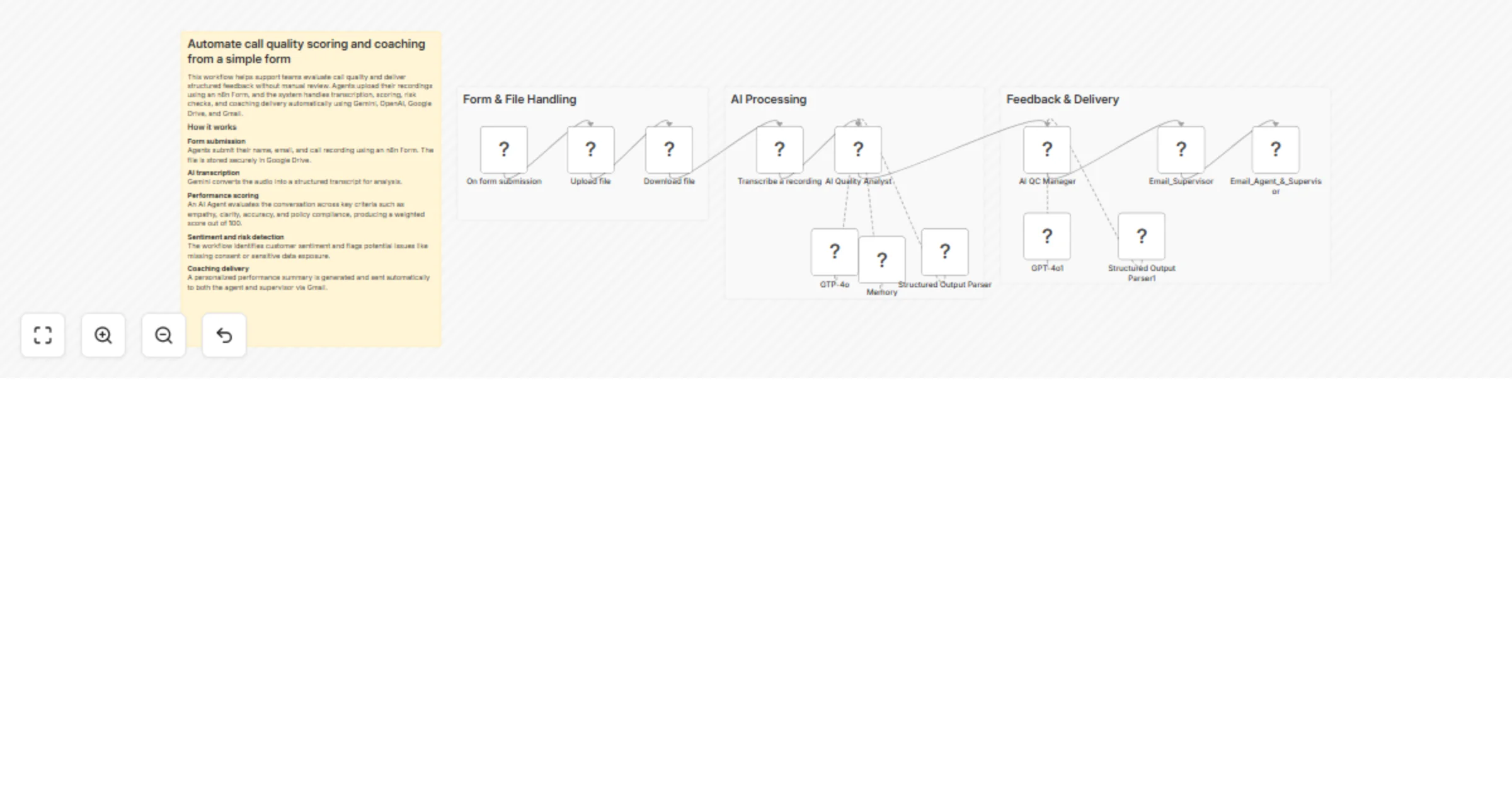
Original n8n.io sourceThis workflow helps support teams evaluate call quality and deliver structured feedback without manual review. Agents upload their recordings using an n8n Form, and the system handles transcription, scoring, risk checks, and coaching delivery automatically using Gemini, OpenAI, Google Drive, and Gmail.
Form submission Agents submit their name, email, and call recording using an n8n Form. The file is stored securely in Google Drive.
AI transcription Gemini converts the audio into a structured transcript for analysis.
Performance scoring An AI Agent evaluates the conversation across key criteria such as empathy, clarity, accuracy, and policy compliance, producing a weighted score out of 100.
Sentiment and risk detection The workflow identifies customer sentiment and flags potential issues like missing consent or sensitive data exposure.
Coaching delivery A personalized performance summary is generated and sent automatically to both the agent and supervisor via Gmail.
This catalog entry is organized from the workflow JSON. The node-level section below shows the executable blocks available for review before importing the template.
| Workflow | Collect, score, and coach call quality with forms, Gemini, OpenAI, Gmail, and Google Drive |
|---|---|
| Complexity | advanced |
| Nodes | 17 |
| Categories | Document Extraction, AI Summarization |
| Author | Abdullah Al Shishani |
| Published | 16 Jan 2026 |
Use the JSON export at /data/workflows/12766/12766.json as the source template for this automation.
Open n8n, import the downloaded JSON, and review each node before activating the workflow.
Replace placeholder credentials, API keys, webhook URLs, account IDs, and environment-specific values with your own settings.
Run the workflow manually or in a staging workspace, inspect node output, and confirm downstream systems receive the expected data.
Enable the workflow only after testing, then monitor executions, errors, and rate limits during the first production runs.
Review imported nodes carefully before activation. This catalog entry is intended to help you inspect the workflow structure, understand required services, and find related templates faster.
Node names, credentials, schedules, webhook paths, and external service limits may need adjustment for your workspace.
This workflow helps support teams evaluate call quality and deliver structured feedback without manual review. Agents upload their recordings using an n8n Form, and the system handles transcription...
Review the workflow JSON, configure any required credentials in n8n, and test the automation in a safe workspace before using it in production.
Yes. Use the block-by-block analysis and the downloadable JSON to inspect each node, then adjust credentials, prompts, schedules, filters, or destinations for your Document Extraction, AI Summarization use case.