
Classify documents with easybits Extractor via web form

Workflow preview
Workflow preview
100%
Classify documents with easybits Extractor via web form preview
Open on n8n.io

1. Workflow Overview

What This Workflow Does Upload a document (PDF, PNG, or JPEG) via a hosted web form and let easybits Extractor classify it into one of your defined categories. This workflow handles the upload, fil...

Best for

  • Document Extraction automation workflows
  • AI Summarization automation workflows
  • intermediate n8n builders looking for reusable templates

Tools used

n8n-nodes-base.extractfromfile, n8n-nodes-base.formtrigger, n8n-nodes-base.set, n8n-nodes-base.stickynote, n8n-nodes-base.httprequest

Source and attribution

This workflow is cataloged by N8N Workflows and links back to its original n8n.io source page by Felix.

Original n8n.io source

1.1 Workflow description

Title
Classify documents with easybits Extractor via web form
Workflow name
Classify documents with easybits Extractor via web form

What This Workflow Does

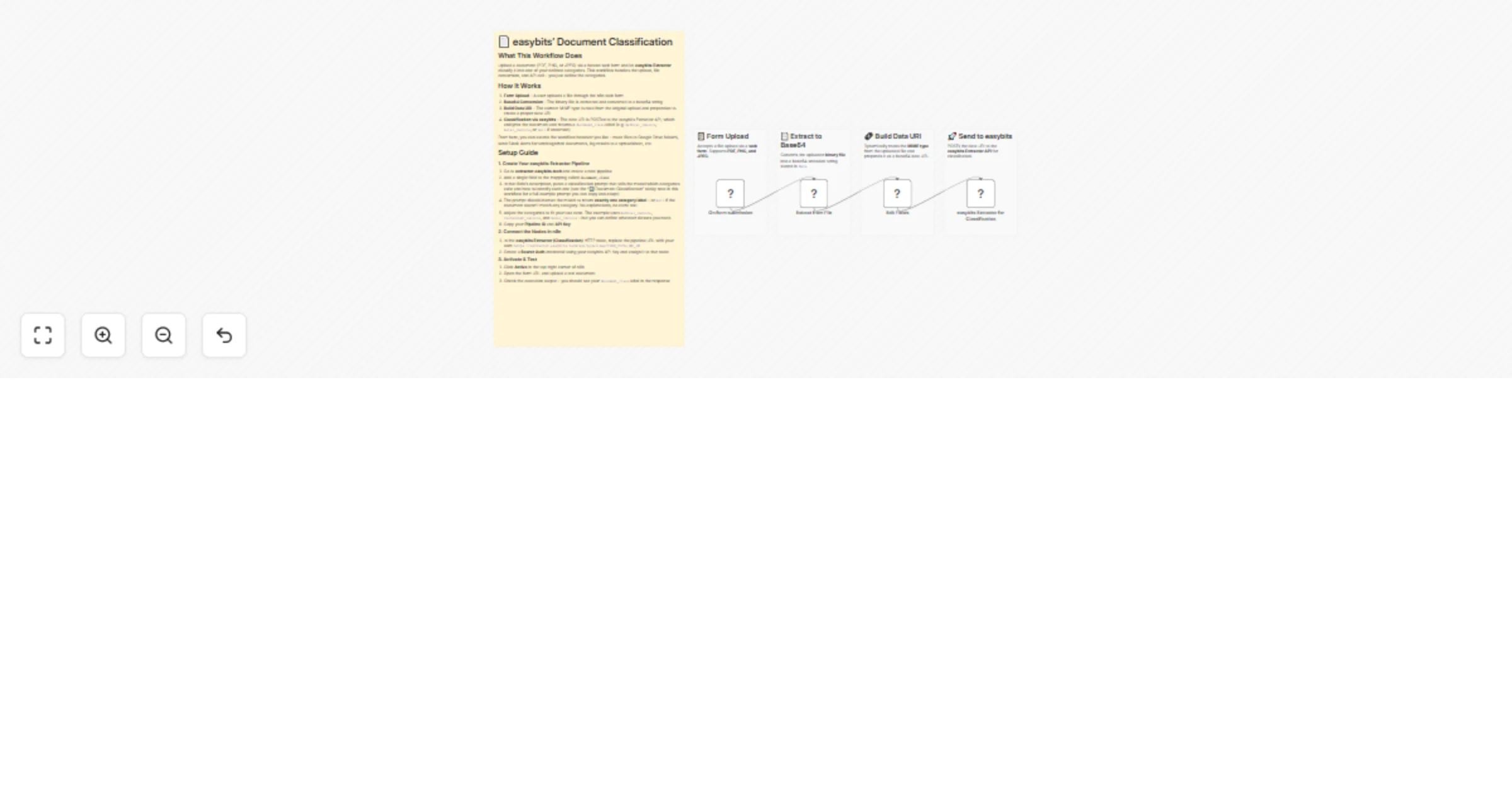
Upload a document (PDF, PNG, or JPEG) via a hosted web form and let easybits Extractor classify it into one of your defined categories. This workflow handles the upload, file conversion, and API call – you just define the categories.

How It Works

  1. Form Upload – A user uploads a file through the n8n web form
  2. Base64 Conversion – The binary file is extracted and converted to a base64 string
  3. Build Data URI – The correct MIME type is read from the original upload and prepended to create a proper data URI
  4. Classification via easybits – The data URI is POSTed to the easybits Extractor API, which analyzes the document and returns a document_class label (e.g. medical_invoice, hotel_invoice, or null if uncertain)

From here, you can extend the workflow however you like – route files to Google Drive folders, send Slack alerts for unrecognized documents, log results to a spreadsheet, etc.


Setup Guide

1. Create Your easybits Extractor Pipeline

  1. Go to https://extractor.easybits.tech/ and create a new pipeline
  2. Add a single field to the mapping called document_class
  3. In that field's description, paste a classification prompt that tells the model which categories exist and how to identify each one.
  4. The prompt should instruct the model to return exactly one category label – or null if the document doesn't match any category. No explanations, no extra text.
  5. Adjust the categories to fit your use case. The example uses medical_invoice, restaurant_invoice, and hotel_invoice – but you can define whatever classes you need.
  6. Copy your Pipeline ID and API Key

2. Connect the Nodes in n8n

  1. In the easybits Extractor (Classification) HTTP node, replace the pipeline URL with your own: https://extractor.easybits.tech/api/pipelines/YOUR_PIPELINE_ID
  2. Create a Bearer Auth credential using your easybits API Key and assign it to that node

3. Activate & Test

  1. Click Active in the top-right corner of n8n
  2. Open the form URL and upload a test document
  3. Check the execution output – you should see your document_class label in the response

1.2 Logical Blocks

This catalog entry is organized from the workflow JSON. The node-level section below shows the executable blocks available for review before importing the template.

2. Block-by-Block Analysis

Block 1 - Extract from File

Type / Role
n8n-nodes-base.extractFromFile - extractFromFile
Config choices
Version 1.1

Block 2 - On form submission

Type / Role
n8n-nodes-base.formTrigger - formTrigger
Config choices
Version 2.5

Block 3 - Edit Fields

Type / Role
n8n-nodes-base.set - set
Config choices
Version 3.4

Block 4 - Sticky Note

Type / Role
n8n-nodes-base.stickyNote - stickyNote
Config choices
Version 1

Block 5 - Sticky Note1

Type / Role
n8n-nodes-base.stickyNote - stickyNote
Config choices
Version 1

Block 6 - Sticky Note2

Type / Role
n8n-nodes-base.stickyNote - stickyNote
Config choices
Version 1

Block 7 - Sticky Note4

Type / Role
n8n-nodes-base.stickyNote - stickyNote
Config choices
Version 1

Block 8 - Sticky Note3

Type / Role
n8n-nodes-base.stickyNote - stickyNote
Config choices
Version 1

Block 9 - easybits Extractor for Classification

Type / Role
n8n-nodes-base.httpRequest - httpRequest
Config choices
Version 4.3

3. Summary Table

Workflow Classify documents with easybits Extractor via web form
Complexity intermediate
Nodes 9
Categories Document Extraction, AI Summarization
Author Felix
Published 25 Mar 2026

4. Reproducing the Workflow from Scratch

  1. 1. Download the workflow JSON

    Use the JSON export at /data/workflows/14314/14314.json as the source template for this automation.

  2. 2. Import the template into n8n

    Open n8n, import the downloaded JSON, and review each node before activating the workflow.

  3. 3. Configure credentials and variables

    Replace placeholder credentials, API keys, webhook URLs, account IDs, and environment-specific values with your own settings.

  4. 4. Test with sample data

    Run the workflow manually or in a staging workspace, inspect node output, and confirm downstream systems receive the expected data.

  5. 5. Activate and monitor

    Enable the workflow only after testing, then monitor executions, errors, and rate limits during the first production runs.

5. General Notes & Resources

Review imported nodes carefully before activation. This catalog entry is intended to help you inspect the workflow structure, understand required services, and find related templates faster.

Node names, credentials, schedules, webhook paths, and external service limits may need adjustment for your workspace.

Frequently asked questions

What does Classify documents with easybits Extractor via web form do?

What This Workflow Does Upload a document (PDF, PNG, or JPEG) via a hosted web form and let easybits Extractor classify it into one of your defined categories. This workflow handles the upload, fil...

What do I need before importing this workflow?

Review the workflow JSON, configure any required credentials in n8n, and test the automation in a safe workspace before using it in production.

Can I customize this workflow?

Yes. Use the block-by-block analysis and the downloadable JSON to inspect each node, then adjust credentials, prompts, schedules, filters, or destinations for your Document Extraction, AI Summarization use case.



