Build a Telegram AI assistant with MemMachine, OpenAI, and voice support
Workflow preview


 Early Deal
DISCOUNT 20%

Important notice
This workflow is provided as-is. Please review and test before using in production.
Overview
Build a Telegram assistant with MemMachine and voice support
An AI assistant that NEVER forgets using MemMachine for persistent cross-session memory, with voice transcription support and productivity tools.
⚠️ Important Deployment Note: This workflow is designed for self-hosted n8n instances. If you're using n8n Cloud, you'll need to deploy MemMachine to a cloud server and update the HTTP Request URLs in nodes 4, 5, and 9.
What This Template Does
This workflow creates an intelligent personal assistant that maintains perfect memory across all conversations, whether you message today or weeks from now. It supports both text and voice messages, automatically transcribes voice using OpenAI Whisper, and provides tools for Gmail, Google Sheets, and Google Calendar.
Key Features
- 🧠 Perfect Memory - Remembers every conversation using MemMachine
- 🎤 Voice Transcription - Supports voice messages via OpenAI Whisper
- 📧 Gmail Integration - Send and read emails
- 📊 Google Sheets - Read and write spreadsheet data
- 📅 Google Calendar - Create and manage events
- 🔧 MCP Tools - Extensible tool architecture
- 💬 Smart Context - References past conversations naturally
Real-World Example
Day 1 - Text Message:
- User: "Send an email to [email protected] about the Q1 report"
- AI: Uses Gmail tool "Email sent to John about the Q1 report!"
Day 3 - Voice Message:
- 🎤 User: "What did I ask you to do for John?"
- AI: "On January 5th, you asked me to email John about the Q1 report, which I sent."
Day 7 - Text Message:
- User: "Follow up with John"
- AI: "I'll send a follow-up email to [email protected] about the Q1 report that we discussed on Jan 5th."
The AI remembers who John is, what you discussed, and when it happened - all without you having to repeat yourself!
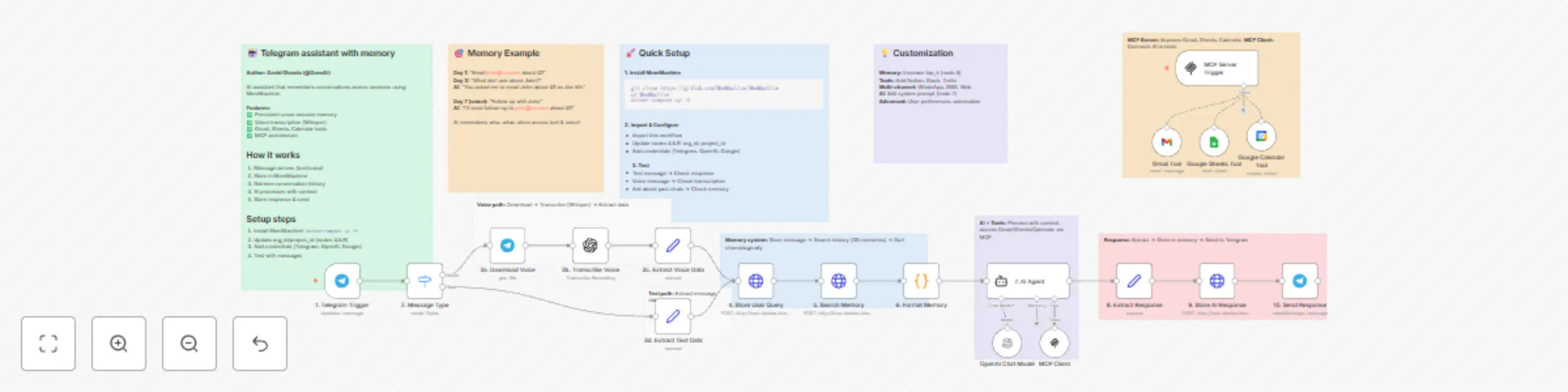
How It Works
Message Flow
For Text Messages:
- Telegram Trigger receives message
- Extract user data and message text
- Store message in MemMachine
- Search conversation history (last 30 memories)
- AI processes with full context + tools
- Store AI response for future reference
- Send reply to user
For Voice Messages:
- Telegram Trigger receives voice message
- Download voice file
- OpenAI Whisper transcribes to text
- Extract transcribed text and user data
- Store in MemMachine (same as text flow)
- Process with AI + tools
- Send reply to user
Requirements
Services & Credentials
- MemMachine - Open-source memory system (self-hosted via Docker)
- Telegram Bot Token - From @BotFather
- OpenAI API Key - For AI responses and voice transcription
- Gmail OAuth - For email integration (optional)
- Google Sheets OAuth - For spreadsheet access (optional)
- Google Calendar OAuth - For calendar management (optional)
Installation
MemMachine Setup
# Clone and start MemMachine
git clone https://github.com/MemMachine/MemMachine
cd MemMachine
docker-compose up -d

# Verify it's running
curl http://localhost:8080/health
Workflow Configuration
Deployment Options
This workflow supports two deployment scenarios:
Option 1: Self-Hosted n8n (Recommended)
- Both n8n and MemMachine run locally
- Best for: Personal use, development, testing
- Setup:
- Run MemMachine:
docker-compose up -d - Use
http://host.docker.internal:8080in HTTP Request nodes (if n8n in Docker) - Or use
http://localhost:8080(if n8n installed directly)
- Run MemMachine:
Option 2: n8n Cloud
- n8n hosted by n8n.io, MemMachine on your cloud server
- Best for: Production, team collaboration
- Setup:
- Deploy MemMachine to cloud (DigitalOcean, AWS, GCP, etc.)
- Expose MemMachine via HTTPS with SSL certificate
- Update HTTP Request URLs in nodes 4, 5, 9 to:
https://your-memmachine-domain.com - Ensure firewall allows n8n Cloud IP addresses
Configuration Steps
Import this template into your n8n instance
Update MemMachine URLs (nodes 4, 5, 9):
- Self-hosted n8n in Docker:
http://host.docker.internal:8080 - Self-hosted n8n (direct install):
http://localhost:8080 - n8n Cloud:
https://your-memmachine-domain.com
- Self-hosted n8n in Docker:
Set Organization IDs (nodes 4, 5, 9):
- Change
your-org-idto your organization name - Change
your-project-idto your project name
- Change
Add Credentials:
- Telegram Bot Token (node 1)
- OpenAI API Key (nodes 4, 7)
- Gmail OAuth (Gmail Tool node)
- Google Sheets OAuth (Sheets Tool node)
- Google Calendar OAuth (Calendar Tool node)
Use Cases
Personal Productivity
- "Remind me what I worked on last week"
- "Schedule a meeting with the team next Tuesday"
- "Email Sarah about the proposal"
Customer Support
- AI remembers customer history
- References past conversations
- Provides contextual support
Task Management
- Track tasks across days/weeks
- Remember project details
- Follow up on action items
Email Automation
- "Send that email to John" (remembers John's email)
- "What emails did I send yesterday?"
- "Draft an email to the team"
Calendar Management
- "What's on my calendar tomorrow?"
- "Schedule a meeting with Alex at 3pm"
- "Cancel my 2pm meeting"
Customization Guide
Extend Memory Capacity
In Node 5 (Search Memory), adjust:
"top_k": 30 // Increase for more context (costs more tokens)
Modify AI Personality
In Node 7 (AI Agent), edit the system prompt to:
- Change tone/style
- Add domain-specific knowledge
- Include company policies
- Set behavioral guidelines
Add More Tools
Connect additional n8n tool nodes to the AI Agent:
- Notion integration
- Slack notifications
- Trello/Asana tasks
- Database queries
- Custom API tools
Multi-Channel Memory
Create similar workflows for:
- WhatsApp (same MemMachine instance)
- SMS via Twilio (same memory database)
- Web chat widget (shared context)
All channels can share the same memory by using consistent customer_email identifiers!
Memory Architecture
Storage Structure
Every message is stored with:
{
  "content": "message text",
  "producer": "[email protected]",
  "role": "user" or "assistant",
  "metadata": {
    "customer_email": "[email protected]",
    "channel": "telegram",
    "username": "john_doe",
    "timestamp": "2026-01-07T12:00:00Z"
  }
}
Retrieval & Formatting
- Search - Finds relevant memories by customer email
- Sort - Orders chronologically (oldest to newest)
- Format - Presents last 20 messages to AI
- Context - AI uses history to inform responses
Cost Estimate
- MemMachine: Free (self-hosted via Docker)
- OpenAI API:
- Text responses: ~$0.001 per message (GPT-4o-mini)
- Voice transcription: ~$0.006 per minute (Whisper)
- n8n: Free (self-hosted) or $20/month (cloud)
- Google APIs: Free tier available
Monthly estimate for 1,000 messages (mix of text/voice):
- OpenAI: $5-15
- Google APIs: $0 (within free tier)
- Total: $5-15/month
Troubleshooting
Deployment Issues
n8n Cloud: Can't connect to MemMachine
- Ensure MemMachine is publicly accessible via HTTPS
- Check firewall rules allow n8n Cloud IPs
- Verify SSL certificate is valid
- Test endpoint:
curl https://your-domain.com/health
Self-Hosted: Can't connect to MemMachine
- Check Docker is running:
docker ps - Verify URL matches your setup
- Test endpoint:
curl http://localhost:8080/health
Voice not transcribing
- Verify OpenAI API key is valid
- Check API key has Whisper access
- Test with short voice message first
AI not remembering
- Verify
org_idandproject_idmatch in nodes 4, 5, 9 - Check
customer_emailis consistent - Review node 5 output (are memories retrieved?)
Tools not working
- Verify OAuth credentials are valid
- Check required API scopes/permissions
- Test tools individually first
Advanced Features
Cloud Deployment Guide (For n8n Cloud Users)
If you're using n8n Cloud, follow these steps to deploy MemMachine:
1. Choose a Cloud Provider
- DigitalOcean (Droplet: $6/month)
- AWS (EC2 t3.micro)
- Google Cloud (e2-micro)
- Render.com (easiest, free tier available)
2. Deploy MemMachine
For DigitalOcean/AWS/GCP:
# SSH into your server
ssh root@your-server-ip

# Install Docker
curl -fsSL https://get.docker.com -o get-docker.sh
sh get-docker.sh

# Clone and start MemMachine
git clone https://github.com/MemMachine/MemMachine
cd MemMachine
docker-compose up -d
3. Configure HTTPS (Required for n8n Cloud)
# Install Caddy for automatic HTTPS
apt install caddy

# Create Caddyfile
cat > /etc/caddy/Caddyfile << 'CADDYEND'
your-domain.com {
    reverse_proxy localhost:8080
}
CADDYEND

# Start Caddy
systemctl start caddy
4. Update Workflow
- In nodes 4, 5, 9, change URL to:
https://your-domain.com - Remove the
/api/v2/memoriespart is already in the path
5. Security Best Practices
- Use environment variables for org_id and project_id
- Enable firewall:
ufw allow 80,443/tcp - Regular backups of MemMachine data
- Monitor server resources
Semantic Memory
MemMachine automatically extracts semantic facts from conversations for better recall of important information.
Chronological Context
Memories are sorted by timestamp, not relevance, to maintain natural conversation flow.
Cross-Session Persistence
Unlike session-based chatbots, this assistant remembers across days, weeks, or months.
Multi-Modal Input
Seamlessly handles both text and voice, storing transcriptions alongside text messages.
Template Information
Author: David Olusola
Version: 1.0.0
Created: January 2026
Support & Resources
- MemMachine Documentation: https://github.com/MemMachine/MemMachine
- n8n Community: https://community.n8n.io
- OpenAI Whisper: https://platform.openai.com/docs/guides/speech-to-text
Contributing
Found a bug or have an improvement? Contribute to the template or share your modifications with the n8n community!
Start building your perfect-memory AI assistant today! 🚀