Block 1 - Crypto
- Type / Role
- n8n-nodes-base.crypto - crypto
- Config choices
- Version 1
This workflow is provided as-is. Please review and test before using in production.
How it works This implementation aggregates incoming data into a Redis list from potentially concurrent workflow executions. It buffers the data for a set period before a single execution retrieves...
n8n-nodes-base.crypto, n8n-nodes-base.redis, n8n-nodes-base.if, n8n-nodes-base.wait, n8n-nodes-base.splitout, n8n-nodes-base.executeworkflowtrigger, n8n-nodes-base.stickynote
This workflow is cataloged by N8N Workflows and links back to its original n8n.io source page by Gregory.
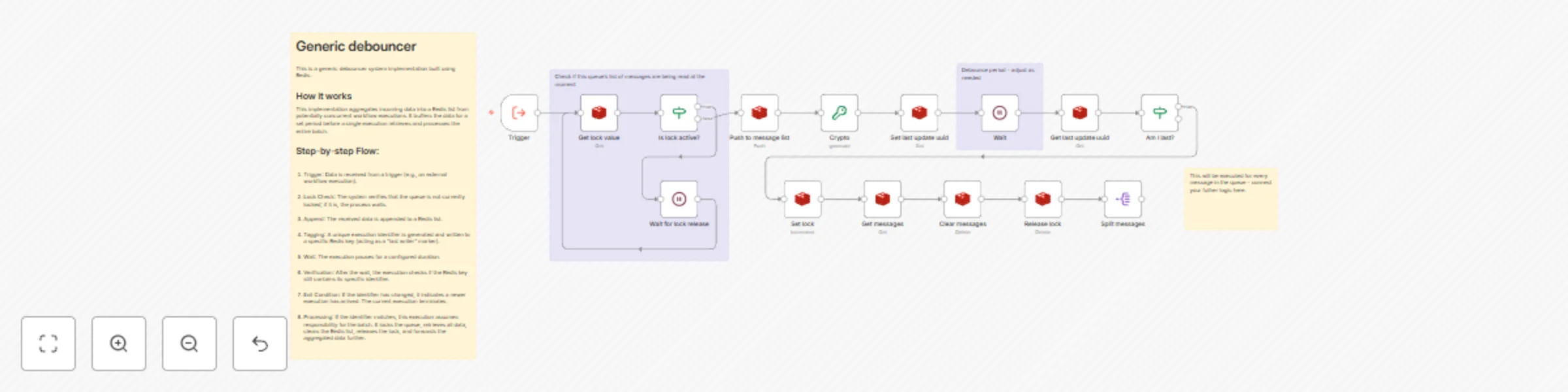
Original n8n.io sourceThis implementation aggregates incoming data into a Redis list from potentially concurrent workflow executions. It buffers the data for a set period before a single execution retrieves and processes the entire batch.
Trigger: Data is received from a trigger (e.g., an external workflow execution).
Lock Check: The system verifies that the queue is not currently locked; if it is, the process waits.
Append: The received data is appended to a Redis list.
Tagging: A unique execution identifier is generated and written to a specific Redis key (acting as a "last writer" marker).
Wait: The execution pauses for a configured duration.
Verification: After the wait, the execution checks if the Redis key still contains its specific identifier.
Exit Condition: If the identifier has changed, it indicates a newer execution has arrived. The current execution terminates.
Processing: If the identifier matches, this execution assumes responsibility for the batch. It locks the queue, retrieves all data, clears the Redis list, releases the lock, and forwards the aggregated data further.
This catalog entry is organized from the workflow JSON. The node-level section below shows the executable blocks available for review before importing the template.
| Workflow | Batch process data with Redis-powered debouncing system |
|---|---|
| Complexity | advanced |
| Nodes | 19 |
| Categories | Engineering |
| Author | Gregory |
| Published | 20 Nov 2025 |
Use the JSON export at /data/workflows/11045/11045.json as the source template for this automation.
Open n8n, import the downloaded JSON, and review each node before activating the workflow.
Replace placeholder credentials, API keys, webhook URLs, account IDs, and environment-specific values with your own settings.
Run the workflow manually or in a staging workspace, inspect node output, and confirm downstream systems receive the expected data.
Enable the workflow only after testing, then monitor executions, errors, and rate limits during the first production runs.
Review imported nodes carefully before activation. This catalog entry is intended to help you inspect the workflow structure, understand required services, and find related templates faster.
Node names, credentials, schedules, webhook paths, and external service limits may need adjustment for your workspace.
How it works This implementation aggregates incoming data into a Redis list from potentially concurrent workflow executions. It buffers the data for a set period before a single execution retrieves...
Review the workflow JSON, configure any required credentials in n8n, and test the automation in a safe workspace before using it in production.
Yes. Use the block-by-block analysis and the downloadable JSON to inspect each node, then adjust credentials, prompts, schedules, filters, or destinations for your Engineering use case.