
Back up workflows from multiple n8n instances to Google Drive

Workflow preview
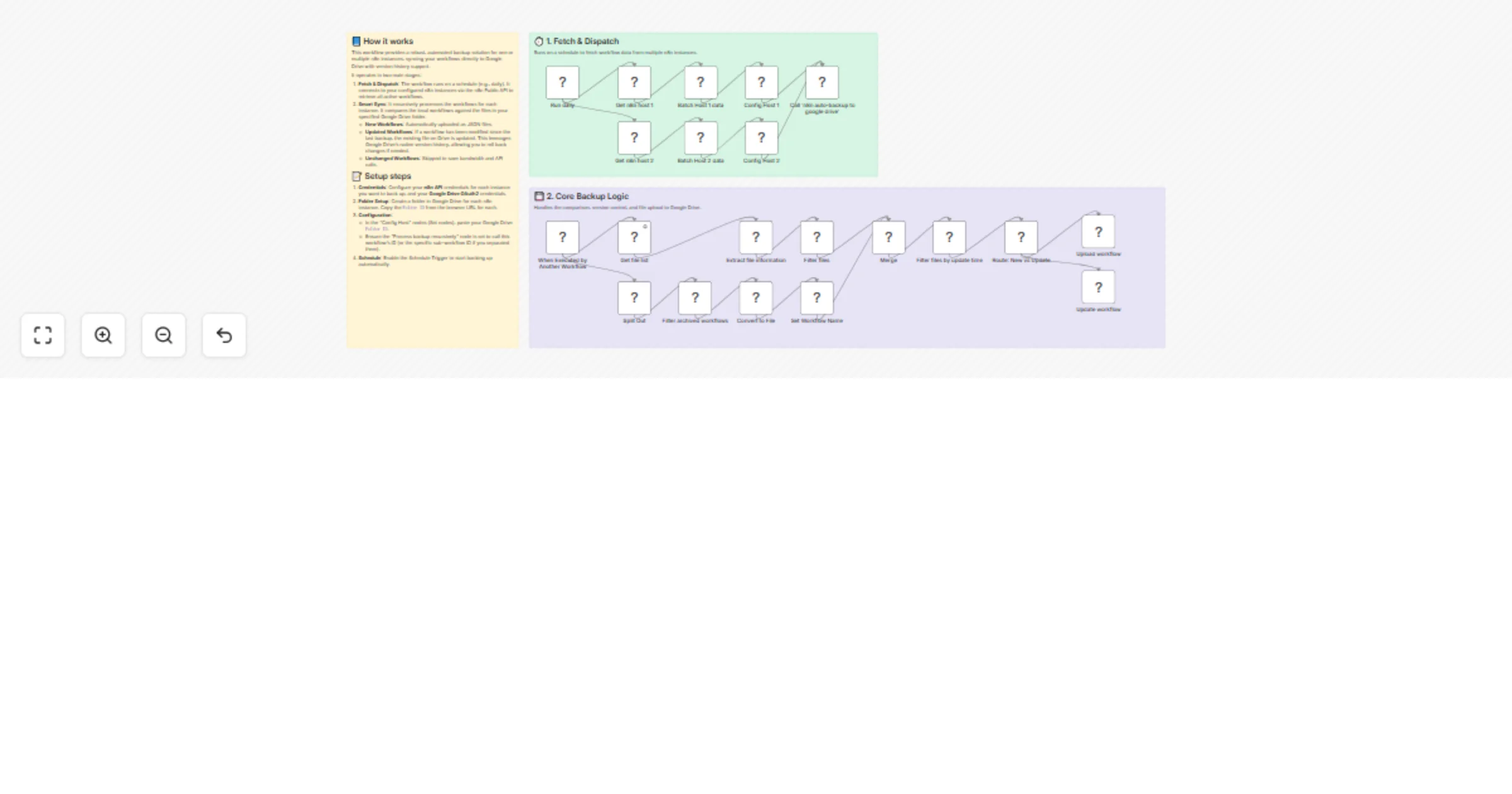
Workflow preview
100%
Back up workflows from multiple n8n instances to Google Drive preview
Open on n8n.io

1. Workflow Overview

Back up n8n workflows to Google Drive automatically This workflow provides a robust solution for backing up your n8n workflows to Google Drive. It is designed to handle backups for multiple n8n ins...

Best for

  • DevOps automation workflows
  • advanced n8n builders looking for reusable templates

Tools used

n8n-nodes-base.executeworkflowtrigger, n8n-nodes-base.merge, n8n-nodes-base.splitout, n8n-nodes-base.converttofile, n8n-nodes-base.executeworkflow, n8n-nodes-base.n8n, n8n-nodes-base.googledrive, n8n-nodes-base.set

Source and attribution

This workflow is cataloged by N8N Workflows and links back to its original n8n.io source page by CryoZeroLabs.

Original n8n.io source

1.1 Workflow description

Title
Back up workflows from multiple n8n instances to Google Drive
Workflow name
Back up workflows from multiple n8n instances to Google Drive

Back up n8n workflows to Google Drive automatically This workflow provides a robust solution for backing up your n8n workflows to Google Drive. It is designed to handle backups for multiple n8n instances centrally and leverages Google Drive's native file versioning to keep your history clean. ๐Ÿš€

โœจ Key Features ๐Ÿ”„ Smart Version Control: Instead of creating a new file for every backup, this workflow checks if the file exists and updates it. This utilizes Google Drive's built-in "Manage Versions" feature, allowing you to rollback changes without cluttering your folder.

๐ŸŒ Multi-Instance Support: Easily backup workflows from multiple n8n servers (e.g., Development, Production) in one go.

โšก Efficiency: Filters out inactive or archived workflows to save resources.

๐Ÿงฉ Self-Contained Logic: Uses a recursive design to process workflows efficiently.

โš™๏ธ How It Works The workflow operates in two main stages:

Fetch & Dispatch:

Run daily: The workflow triggers on a schedule.

Fetch workflows: It connects to your configured n8n instances via the n8n Public API to retrieve all active workflows.

It then batches the data and configures the target folders for each host.

Core Backup Logic:

Process backup recursively: The workflow calls itself to process the list.

Drive Comparison: It lists files in the target Google Drive folder and compares them with the n8n workflows.

Smart Sync:

๐Ÿ†• New: If the workflow doesn't exist on Drive, it uploads a new file.

โ™ป๏ธ Update: If the workflow exists but has been modified, it updates the existing file (preserving the file ID and history).

๐Ÿ“ Setup Instructions

  1. ๐Ÿ”‘ Credentials Set up Google Drive OAuth2 API credentials.

Set up n8n API credentials for each instance you want to backup.

  1. ๐Ÿ“‚ Configure Folder IDs Create a folder in Google Drive for your backups and copy the Folder ID from the URL.

Open the nodes named Config Host 1 (and Config Host 2, etc.).

Replace the value for targetFloderId with your actual Google Drive Folder ID.

  1. ๐Ÿ”— Link the Sub-Workflow โš ๏ธ Important: This workflow calls itself to process the data recursively.

Open the node named Process backup recursively.

Ensure the Workflow ID field is pointing to this workflow's ID (you can select it from the list after saving the workflow for the first time).

๐Ÿ› ๏ธ Requirements n8n Service Account or API Key.

Google Cloud Console Project with Google Drive API enabled.

1.2 Logical Blocks

This catalog entry is organized from the workflow JSON. The node-level section below shows the executable blocks available for review before importing the template.

2. Block-by-Block Analysis

Block 1 - When Executed by Another Workflow

Type / Role
n8n-nodes-base.executeWorkflowTrigger - executeWorkflowTrigger
Config choices
Version 1.1

Block 2 - Merge

Type / Role
n8n-nodes-base.merge - merge
Config choices
Version 3.2

Block 3 - Split Out

Type / Role
n8n-nodes-base.splitOut - splitOut
Config choices
Version 1

Block 4 - Convert to File

Type / Role
n8n-nodes-base.convertToFile - convertToFile
Config choices
Version 1.1

Block 5 - Call 'n8n auto-backup to google drive'

Type / Role
n8n-nodes-base.executeWorkflow - executeWorkflow
Config choices
Version 1.3

Block 6 - Get n8n host 1

Type / Role
n8n-nodes-base.n8n - n8n
Config choices
Version 1

Block 7 - Get n8n host 2

Type / Role
n8n-nodes-base.n8n - n8n
Config choices
Version 1

Block 8 - Update workflow

Type / Role
n8n-nodes-base.googleDrive - googleDrive
Config choices
Version 3

Block 9 - Upload workflow

Type / Role
n8n-nodes-base.googleDrive - googleDrive
Config choices
Version 3

Block 10 - Get file list

Type / Role
n8n-nodes-base.googleDrive - googleDrive
Config choices
Version 3

Block 11 - Extract file information

Type / Role
n8n-nodes-base.set - set
Config choices
Version 3.4

Block 12 - Set Workflow Name

Type / Role
n8n-nodes-base.set - set
Config choices
Version 3.4

Block 13 - Filter files

Type / Role
n8n-nodes-base.filter - filter
Config choices
Version 2.3

Block 14 - Filter files by update time

Type / Role
n8n-nodes-base.filter - filter
Config choices
Version 2.3

Block 15 - Run daily

Type / Role
n8n-nodes-base.scheduleTrigger - scheduleTrigger
Config choices
Version 1.3

Block 16 - Batch Host 1 data

Type / Role
n8n-nodes-base.aggregate - aggregate
Config choices
Version 1

Block 17 - Batch Host 2 data

Type / Role
n8n-nodes-base.aggregate - aggregate
Config choices
Version 1

Block 18 - Route: New vs Update

Type / Role
n8n-nodes-base.if - if
Config choices
Version 2.3

Block 19 - Filter archived workflows

Type / Role
n8n-nodes-base.filter - filter
Config choices
Version 2.3

Block 20 - Sticky Note6

Type / Role
n8n-nodes-base.stickyNote - stickyNote
Config choices
Version 1

Block 21 - Sticky Note

Type / Role
n8n-nodes-base.stickyNote - stickyNote
Config choices
Version 1

Block 22 - Sticky Note1

Type / Role
n8n-nodes-base.stickyNote - stickyNote
Config choices
Version 1

Block 23 - Config Host 2

Type / Role
n8n-nodes-base.set - set
Config choices
Version 3.4

Block 24 - Config Host 1

Type / Role
n8n-nodes-base.set - set
Config choices
Version 3.4

3. Summary Table

Workflow Back up workflows from multiple n8n instances to Google Drive
Complexity advanced
Nodes 24
Categories DevOps
Author CryoZeroLabs
Published 16 Jan 2026

4. Reproducing the Workflow from Scratch

  1. 1. Download the workflow JSON

    Use the JSON export at /data/workflows/12747/12747.json as the source template for this automation.

  2. 2. Import the template into n8n

    Open n8n, import the downloaded JSON, and review each node before activating the workflow.

  3. 3. Configure credentials and variables

    Replace placeholder credentials, API keys, webhook URLs, account IDs, and environment-specific values with your own settings.

  4. 4. Test with sample data

    Run the workflow manually or in a staging workspace, inspect node output, and confirm downstream systems receive the expected data.

  5. 5. Activate and monitor

    Enable the workflow only after testing, then monitor executions, errors, and rate limits during the first production runs.

5. General Notes & Resources

Review imported nodes carefully before activation. This catalog entry is intended to help you inspect the workflow structure, understand required services, and find related templates faster.

Node names, credentials, schedules, webhook paths, and external service limits may need adjustment for your workspace.

Frequently asked questions

What does Back up workflows from multiple n8n instances to Google Drive do?

Back up n8n workflows to Google Drive automatically This workflow provides a robust solution for backing up your n8n workflows to Google Drive. It is designed to handle backups for multiple n8n ins...

What do I need before importing this workflow?

Review the workflow JSON, configure any required credentials in n8n, and test the automation in a safe workspace before using it in production.

Can I customize this workflow?

Yes. Use the block-by-block analysis and the downloadable JSON to inspect each node, then adjust credentials, prompts, schedules, filters, or destinations for your DevOps use case.



