Automatically optimize AI prompts with OpenAI using OPRO & DSPy methodology
Workflow preview

$20/month : Unlimited workflows
2500 executions/month

THE #1 IN WEB SCRAPING
Scrape any website without limits
HOSTINGER  Early Deal
DISCOUNT 20% Try free
Early DealDISCOUNT 20%
Self-hosted n8n
Unlimited workflows - from $4.99/mo

#1 hub for scraping, AI & automation
6000+ actors - $5 credits/mo
Important notice
This workflow is provided as-is. Please review and test before using in production.
Overview
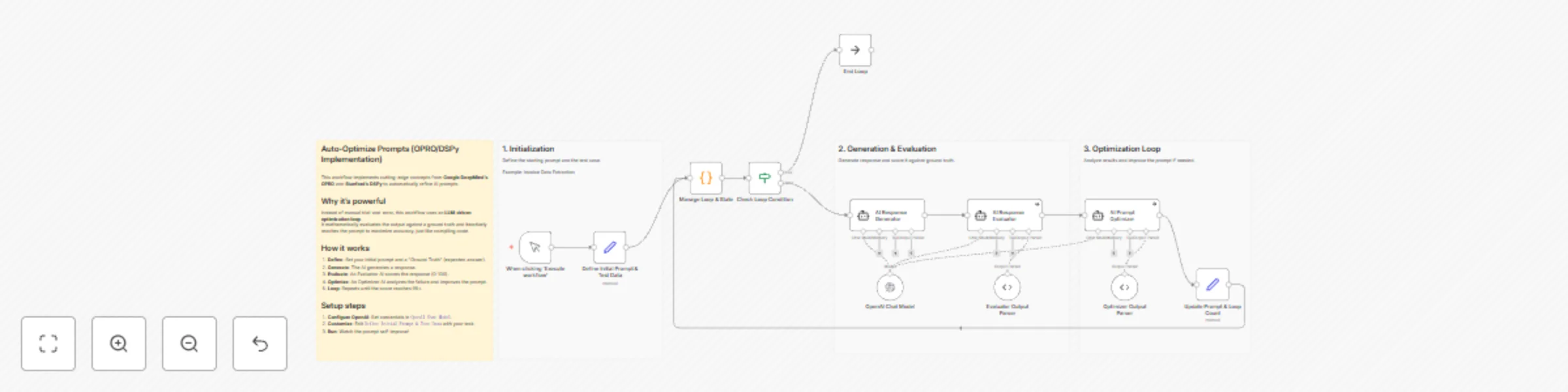
This workflow implements cutting-edge concepts from Google DeepMind's OPRO (Optimization by PROmpting) and Stanford's DSPy to automatically refine AI prompts. It iteratively generates, evaluates, and optimizes responses against a ground truth, allowing you to "compile" your prompts for maximum accuracy.
Why this is powerful
Instead of manually tweaking prompts (trial and error), this workflow treats prompt engineering as an optimization problem:
- OPRO-style Optimization: The "Optimizer" LLM analyzes past performance scores and reasons to mathematically deduce a better prompt.
- DSPy-style Logic: It separates the "Logic" (Workflow) from the "Parameters" (Prompts), allowing the system to self-correct until it matches the Ground Truth.
How it works
- Define: Set your initial prompt and a test case with the expected answer (Ground Truth).
- Generate: The workflow generates a response using the current prompt.
- Evaluate: An AI Evaluator scores the response (0-100) based on accuracy and format.
- Optimize: If the score is low, the Optimizer AI analyzes the failure and rewrites the prompt.
- Loop: The process repeats until the score reaches 95/100 or the loop limit is hit.
Setup steps
- Configure OpenAI: Ensure you have an OpenAI credential set up in the
OpenAI Chat Modelnode. - Customize: Open the
Define Initial Prompt & Test Datanode and set yourinitial_prompt,test_input, andground_truth. - Run: Execute the workflow and check the
Manage Loop & Statenode output for the optimized prompt.