
Automated Spotify playlist organizer - sort and queue tracks by popularity

Workflow preview
Workflow preview
100%
Automated Spotify playlist organizer - sort and queue tracks by popularity preview
Open on n8n.io

Important notice

This workflow is provided as-is. Please review and test before using in production.

1. Workflow Overview

Automated Spotify Playlist Organizer — Sort and Queue Tracks by Popularity Overview This workflow acts as your AI powered Spotify DJ assistant. It retrieves your playlists, cleans and organiz...

Best for

  • Miscellaneous automation workflows
  • intermediate n8n builders looking for reusable templates

Tools used

n8n-nodes-base.manualtrigger, n8n-nodes-base.spotify, n8n-nodes-base.splitinbatches, n8n-nodes-base.code, n8n-nodes-base.stickynote

Source and attribution

This workflow is cataloged by N8N Workflows and links back to its original n8n.io source page by Arthur Dimeglio.

Original n8n.io source

1.1 Workflow description

Title
Automated Spotify playlist organizer - sort and queue tracks by popularity
Workflow name
Automated Spotify playlist organizer - sort and queue tracks by popularity

🎧 Automated Spotify Playlist Organizer — Sort and Queue Tracks by Popularity

🧠 Overview

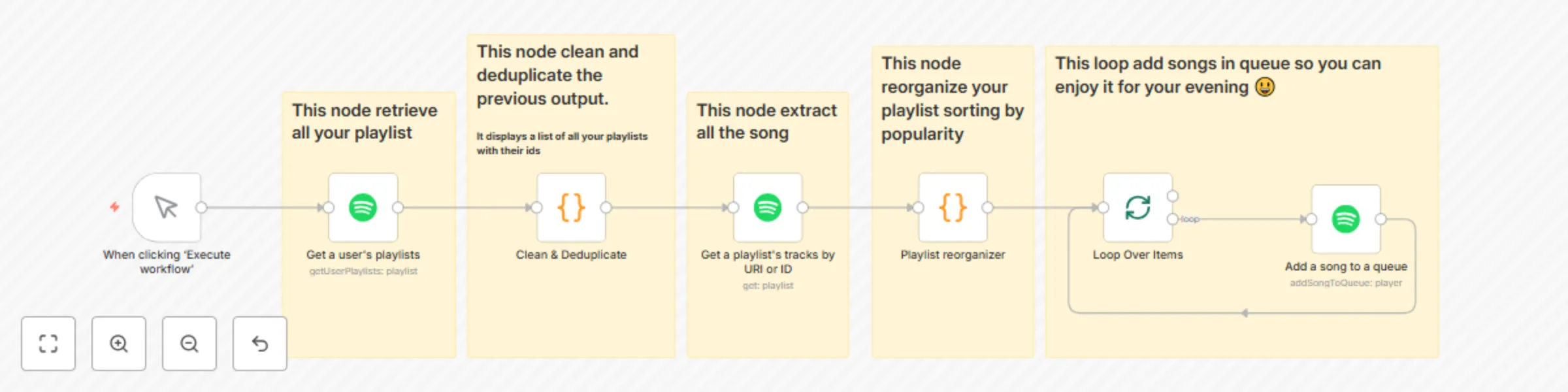
This workflow acts as your AI-powered Spotify DJ assistant. It retrieves your playlists, cleans and organizes them, sorts tracks by popularity, and automatically queues them for playback — creating a ready-to-play, personalized listening session.

⚙️ Step-by-Step Breakdown

  1. Manual Trigger

Node: When clicking ‘Execute workflow’ Starts the workflow manually when you click “Execute” in n8n.

  1. Get User’s Playlists

Node: Get a user’s playlists • Uses your Spotify OAuth credentials. • Calls Spotify’s API to retrieve all playlists from your account (returnAll: true). • Output: an array of playlists (name, URI, number of tracks, etc.).

🟢 This is your raw data source.

  1. Clean & Deduplicate

Node: Clean & Deduplicate (Code node) This JavaScript block: • Normalizes input (handles arrays and multiple items). • Extracts only useful fields: name, uri, total. • Filters out playlists missing data. • Removes duplicates by URI.

🧹 Result: a clean, uniform list of your playlists.

  1. Get a Playlist’s Tracks

Node: Get a playlist’s tracks by URI or ID • Fetches all tracks from a specific playlist. • Returns detailed info: name, popularity, artists, album, added date, etc.

🎵 This retrieves the actual songs from your chosen playlist.

  1. Playlist Reorganizer

Node: Playlist reorganizer (Code node) This JavaScript block: • Collects all tracks from the selected playlist. • Avoids duplicates with seenTrackIds. • Extracts key fields: id, name, popularity, artists, album, added_at, url, etc. • Sorts songs by ascending popularity (less popular first).

📊 Result: playlist reorganized by song popularity.

  1. Loop Over Items

Node: Split in Batches • Iterates over each track one by one. • Sends each song sequentially to the next node (“Add a song to a queue”).

🔁 Allows each song to be processed individually.

  1. Add a Song to a Queue

Node: Add a song to a queue • Uses each song’s Spotify ID to add it to your Spotify playback queue (spotify:track:{{ $json.id }}). • Connected to the “Loop Over Items” node to continue until all songs are queued.

🎶 Result: your Spotify queue fills automatically with the reorganized tracks.

✅ Final Result

When you execute this workflow: 1. It fetches all your playlists. 2. Cleans and filters them. 3. Extracts tracks from one selected playlist. 4. Sorts them by popularity. 5. Adds them to your playback queue.

🎧 End result: a fully automated “AI DJ” that reorganizes your playlists and lines up your music session — from discovery to playback.

🪪 Prerequisites

Before using this workflow: • You must have a Spotify account. • You need to set up Spotify OAuth credentials in n8n (Client ID, Client Secret, Redirect URI). • Ensure you have Spotify Premium (API queueing only works on Premium accounts).

🛠️ Setup Instructions 1. Import this workflow into your n8n instance. 2. Go to the Spotify OAuth2 API credentials section and connect your account.

1.2 Logical Blocks

This catalog entry is organized from the workflow JSON. The node-level section below shows the executable blocks available for review before importing the template.

2. Block-by-Block Analysis

Block 1 - When clicking ‘Execute workflow’

Type / Role
n8n-nodes-base.manualTrigger - manualTrigger
Config choices
Version 1

Block 2 - Get a user's playlists

Type / Role
n8n-nodes-base.spotify - spotify
Config choices
Version 1

Block 3 - Add a song to a queue

Type / Role
n8n-nodes-base.spotify - spotify
Config choices
Version 1

Block 4 - Get a playlist's tracks by URI or ID

Type / Role
n8n-nodes-base.spotify - spotify
Config choices
Version 1

Block 5 - Loop Over Items

Type / Role
n8n-nodes-base.splitInBatches - splitInBatches
Config choices
Version 3

Block 6 - Clean & Deduplicate

Type / Role
n8n-nodes-base.code - code
Config choices
Version 2

Block 7 - Playlist reorganizer

Type / Role
n8n-nodes-base.code - code
Config choices
Version 2

Block 8 - Sticky Note

Type / Role
n8n-nodes-base.stickyNote - stickyNote
Config choices
Version 1

Block 9 - Sticky Note1

Type / Role
n8n-nodes-base.stickyNote - stickyNote
Config choices
Version 1

Block 10 - Sticky Note2

Type / Role
n8n-nodes-base.stickyNote - stickyNote
Config choices
Version 1

Block 11 - Sticky Note3

Type / Role
n8n-nodes-base.stickyNote - stickyNote
Config choices
Version 1

Block 12 - Sticky Note4

Type / Role
n8n-nodes-base.stickyNote - stickyNote
Config choices
Version 1

3. Summary Table

Workflow Automated Spotify playlist organizer - sort and queue tracks by popularity
Complexity intermediate
Nodes 12
Categories Miscellaneous
Author Arthur Dimeglio
Published 19 Oct 2025

4. Reproducing the Workflow from Scratch

  1. 1. Download the workflow JSON

    Use the JSON export at /data/workflows/9888/9888.json as the source template for this automation.

  2. 2. Import the template into n8n

    Open n8n, import the downloaded JSON, and review each node before activating the workflow.

  3. 3. Configure credentials and variables

    Replace placeholder credentials, API keys, webhook URLs, account IDs, and environment-specific values with your own settings.

  4. 4. Test with sample data

    Run the workflow manually or in a staging workspace, inspect node output, and confirm downstream systems receive the expected data.

  5. 5. Activate and monitor

    Enable the workflow only after testing, then monitor executions, errors, and rate limits during the first production runs.

5. General Notes & Resources

Review imported nodes carefully before activation. This catalog entry is intended to help you inspect the workflow structure, understand required services, and find related templates faster.

Node names, credentials, schedules, webhook paths, and external service limits may need adjustment for your workspace.

Frequently asked questions

What does Automated Spotify playlist organizer - sort and queue tracks by popularity do?

Automated Spotify Playlist Organizer — Sort and Queue Tracks by Popularity Overview This workflow acts as your AI powered Spotify DJ assistant. It retrieves your playlists, cleans and organiz...

What do I need before importing this workflow?

Review the workflow JSON, configure any required credentials in n8n, and test the automation in a safe workspace before using it in production.

Can I customize this workflow?

Yes. Use the block-by-block analysis and the downloadable JSON to inspect each node, then adjust credentials, prompts, schedules, filters, or destinations for your Miscellaneous use case.



