
Automated book summarization with DeepSeek AI, Qdrant Vector DB & Google Drive

Workflow preview
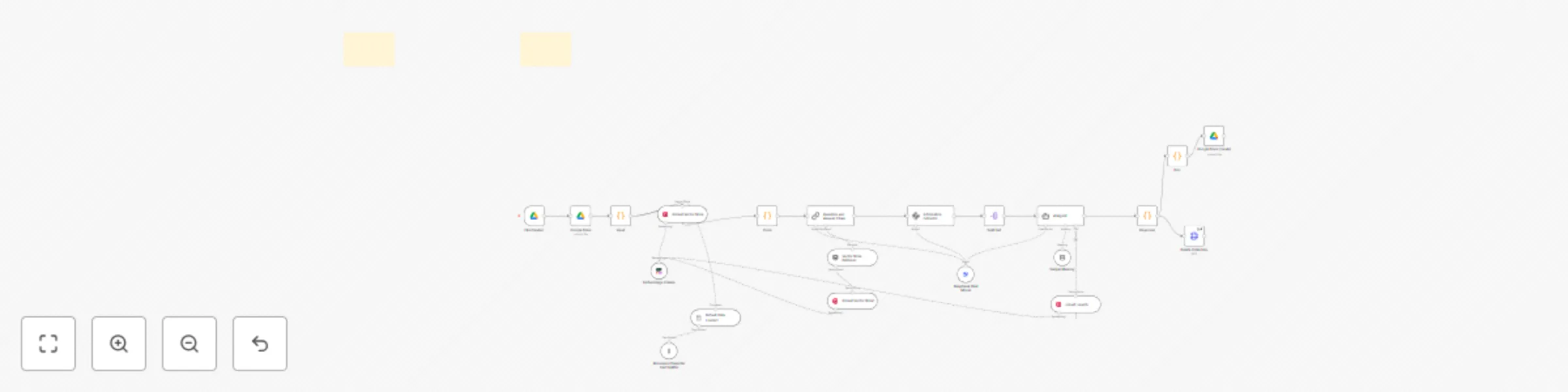
Workflow preview
100%
Automated book summarization with DeepSeek AI, Qdrant Vector DB & Google Drive preview
Open on n8n.io

Important notice

This workflow is provided as-is. Please review and test before using in production.

1. Workflow Overview

AI Book Summarizer with Vector Search – n8n Automation Overview This n8n workflow automates the process of summarizing uploaded books from Google Drive using vector databases and LLMs. It uses C...

Best for

  • Document Extraction automation workflows
  • AI RAG automation workflows
  • advanced n8n builders looking for reusable templates

Tools used

@n8n/n8n-nodes-langchain.vectorstoreqdrant, @n8n/n8n-nodes-langchain.textsplitterrecursivecharactertextsplitter, @n8n/n8n-nodes-langchain.documentdefaultdataloader, @n8n/n8n-nodes-langchain.agent, @n8n/n8n-nodes-langchain.memorybufferwindow, n8n-nodes-base.code, n8n-nodes-base.googledrive, n8n-nodes-base.httprequest

Source and attribution

This workflow is cataloged by N8N Workflows and links back to its original n8n.io source page by Abdellah Homrani.

Original n8n.io source

1.1 Workflow description

Title
Automated book summarization with DeepSeek AI, Qdrant Vector DB & Google Drive
Workflow name
Automated book summarization with DeepSeek AI, Qdrant Vector DB & Google Drive

📚 AI Book Summarizer with Vector Search – n8n Automation

Overview

This n8n workflow automates the process of summarizing uploaded books from Google Drive using vector databases and LLMs. It uses Cohere for embeddings, Qdrant for storage and retrieval, and DeepSeek or your preferred LLM for summarization and Q&A. Designed for researchers, students, and productivity enthusiasts!

Result Example


Problem 🛠️

⏳ Reading full books or papers to extract core ideas can take hours. 🧠 Manually summarizing or searching inside long documents is inefficient and overwhelming.


Solution ✅

Use this workflow to:

  • Upload a book to Google Drive 📥
  • Auto-split and embed the content into Qdrant 🔍
  • Summarize it using DeepSeek or another LLM 🤖
  • Store the final summary back to Google Drive 📤
  • Clean up the vector store afterward 🧹

🔥 Result

⚡ Instant AI-generated book summary 💡 Ability to perform semantic search and question-answering 📁 Summary saved back to your cloud 🧠 Enhanced productivity for learning and research


Setup ⚙️ (4–8 minutes)

1. Google Drive Setup

  • 🔗 Connect Google Drive credentials
  • 📁 Create an input folder (e.g., book_uploads)
  • 📁 Create an output folder (e.g., book_summaries)
  • ⚡ Trigger: Use File Created node to monitor book_uploads
  • 📥 Summary will be saved in book_summaries

2. LLM & Embeddings Setup

  • 🔑 Create and test API keys for:
    • DeepSeek/OpenAI for summarization
    • Cohere for embeddings
    • Qdrant for vector storage
  • 🧪 Ensure all credentials are added in n8n

How It Works 🌟

  1. 📂 A file is uploaded to Google Drive
  2. ⬇️ File is downloaded
  3. 🧱 It's processed, split into chunks, and sent to Qdrant using Cohere embeddings
  4. ❓ A Q&A chain with vector retriever performs information extraction
  5. 🧠 A DeepSeek AI Agent analyzes and summarizes the book
  6. 📤 The summary is saved to your Drive
  7. 🧽 The Qdrant vector collection is deleted (clean-up)

What’s Included 📦

  • ✅ Google Drive integration (input/output)
  • ✅ File chunking and embedding using Cohere
  • ✅ Vector storage with Qdrant
  • ✅ Q&A with vector retrieval
  • ✅ Summarization via DeepSeek or other LLM
  • ✅ Clean-up for minimal storage overhead

Customization 🎨

You can tailor it to your use case:

  • 🧑‍🏫 Adjust summarization prompt for study notes or executive summaries
  • 🌍 Add translation node for multilingual support
  • 🔍 Enable long-term memory by skipping vector deletion
  • 📨 Send summaries to Notion, Slack, or Email
  • 🧩 Use other LLM providers (OpenAI, Claude, Gemini, etc.)

🌐 Explore more workflows

❤️ Buy more workflows at: adamcrafts 🦾 Custom workflows at: [email protected] [email protected]

> Build once, customize endlessly, and scale your video content like never before. 🚀

1.2 Logical Blocks

This catalog entry is organized from the workflow JSON. The node-level section below shows the executable blocks available for review before importing the template.

2. Block-by-Block Analysis

Block 1 - Qdrant Vector Store

Type / Role
@n8n/n8n-nodes-langchain.vectorStoreQdrant - vectorStoreQdrant
Config choices
Version 1

Block 2 - Recursive Character Text Splitter

Type / Role
@n8n/n8n-nodes-langchain.textSplitterRecursiveCharacterTextSplitter - textSplitterRecursiveCharacterTextSplitter
Config choices
Version 1

Block 3 - Default Data Loader1

Type / Role
@n8n/n8n-nodes-langchain.documentDefaultDataLoader - documentDefaultDataLoader
Config choices
Version 1

Block 4 - AI Agent

Type / Role
@n8n/n8n-nodes-langchain.agent - agent
Config choices
Version 1.8

Block 5 - Simple Memory

Type / Role
@n8n/n8n-nodes-langchain.memoryBufferWindow - memoryBufferWindow
Config choices
Version 1.3

Block 6 - Code

Type / Role
n8n-nodes-base.code - code
Config choices
Version 2

Block 7 - Google Drive (create)

Type / Role
n8n-nodes-base.googleDrive - googleDrive
Config choices
Version 3

Block 8 - Delete Collection

Type / Role
n8n-nodes-base.httpRequest - httpRequest
Config choices
Version 4.2

Block 9 - Question and Answer Chain

Type / Role
@n8n/n8n-nodes-langchain.chainRetrievalQa - chainRetrievalQa
Config choices
Version 1.5

Block 10 - Vector Store Retriever

Type / Role
@n8n/n8n-nodes-langchain.retrieverVectorStore - retrieverVectorStore
Config choices
Version 1

Block 11 - Qdrant Vector Store1

Type / Role
@n8n/n8n-nodes-langchain.vectorStoreQdrant - vectorStoreQdrant
Config choices
Version 1.1

Block 12 - qdrant_search

Type / Role
@n8n/n8n-nodes-langchain.vectorStoreQdrant - vectorStoreQdrant
Config choices
Version 1.1

Block 13 - Embeddings Cohere

Type / Role
@n8n/n8n-nodes-langchain.embeddingsCohere - embeddingsCohere
Config choices
Version 1

Block 14 - Information Extractor

Type / Role
@n8n/n8n-nodes-langchain.informationExtractor - informationExtractor
Config choices
Version 1

Block 15 - Split Out

Type / Role
n8n-nodes-base.splitOut - splitOut
Config choices
Version 1

Block 16 - Response

Type / Role
n8n-nodes-base.code - code
Config choices
Version 2

Block 17 - Google Drive

Type / Role
n8n-nodes-base.googleDrive - googleDrive
Config choices
Version 3

Block 18 - File Created

Type / Role
n8n-nodes-base.googleDriveTrigger - googleDriveTrigger
Config choices
Version 1

Block 19 - input

Type / Role
n8n-nodes-base.code - code
Config choices
Version 2

Block 20 - DeepSeek Chat Model

Type / Role
@n8n/n8n-nodes-langchain.lmChatDeepSeek - lmChatDeepSeek
Config choices
Version 1

Block 21 - Sticky Note7

Type / Role
n8n-nodes-base.stickyNote - stickyNote
Config choices
Version 1

Block 22 - Sticky Note2

Type / Role
n8n-nodes-base.stickyNote - stickyNote
Config choices
Version 1

Block 23 - Doc

Type / Role
n8n-nodes-base.code - code
Config choices
Version 2

3. Summary Table

Workflow Automated book summarization with DeepSeek AI, Qdrant Vector DB & Google Drive
Complexity advanced
Nodes 23
Categories Document Extraction, AI RAG
Author Abdellah Homrani
Published 01 Jun 2025

4. Reproducing the Workflow from Scratch

  1. 1. Download the workflow JSON

    Use the JSON export at /data/workflows/4566/4566.json as the source template for this automation.

  2. 2. Import the template into n8n

    Open n8n, import the downloaded JSON, and review each node before activating the workflow.

  3. 3. Configure credentials and variables

    Replace placeholder credentials, API keys, webhook URLs, account IDs, and environment-specific values with your own settings.

  4. 4. Test with sample data

    Run the workflow manually or in a staging workspace, inspect node output, and confirm downstream systems receive the expected data.

  5. 5. Activate and monitor

    Enable the workflow only after testing, then monitor executions, errors, and rate limits during the first production runs.

5. General Notes & Resources

Review imported nodes carefully before activation. This catalog entry is intended to help you inspect the workflow structure, understand required services, and find related templates faster.

Node names, credentials, schedules, webhook paths, and external service limits may need adjustment for your workspace.

Frequently asked questions

What does Automated book summarization with DeepSeek AI, Qdrant Vector DB & Google Drive do?

AI Book Summarizer with Vector Search – n8n Automation Overview This n8n workflow automates the process of summarizing uploaded books from Google Drive using vector databases and LLMs. It uses C...

What do I need before importing this workflow?

Review the workflow JSON, configure any required credentials in n8n, and test the automation in a safe workspace before using it in production.

Can I customize this workflow?

Yes. Use the block-by-block analysis and the downloadable JSON to inspect each node, then adjust credentials, prompts, schedules, filters, or destinations for your Document Extraction, AI RAG use case.



