Automate Your RFP Process with OpenAI Assistants
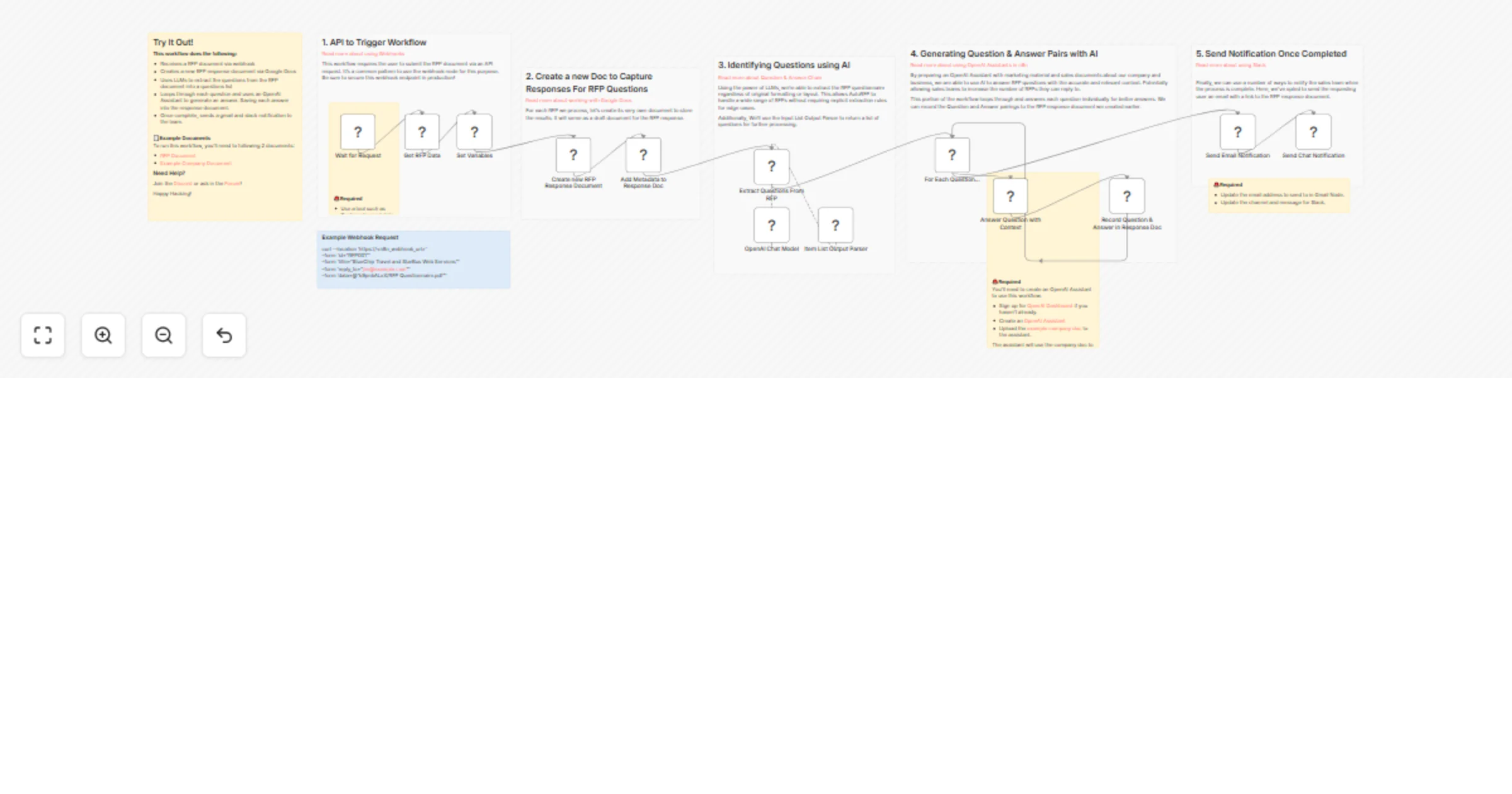
Workflow preview

$20/month : Unlimited workflows
2500 executions/month

THE #1 IN WEB SCRAPING
Scrape any website without limits
HOSTINGER  Early Deal
DISCOUNT 20% Try free
Early DealDISCOUNT 20%
Self-hosted n8n
Unlimited workflows - from $4.99/mo

#1 hub for scraping, AI & automation
6000+ actors - $5 credits/mo
Important notice
This workflow is provided as-is. Please review and test before using in production.
Overview
This n8n workflow demonstrates how to automate oftern time-consuming form filling tasks in the early stages of the tendering process; the Request for Proposal document or "RFP".
It does this by utilising a company's knowledgebase to generating question-and-answer pairs using Large Language Models.
How it works
- A buyer's RFP is submitted to the workflow as a digital document that can be parsed.
- Our first AI agent scans and extracts all questions from the document into list form.
- The supplier sets up an OpenAI assistant prior loaded with company brand, marketing and technical documents.
- The workflow loops through each of the buyer's questions and poses these to the OpenAI assistant.
- The assistant's answers are captured until all questions are satisified and are then exported into a new document for review.
- A sales team member is then able to use this document to respond quickly to the RFP before their competitors.
Example Webhook Request
curl --location 'https://<n8n_webhook_url>' \
--form 'id="RFP001"' \
--form 'title="BlueChip Travel and StarBus Web Services"' \
--form 'reply_to="[email protected]"' \
--form 'data=@"k9pnbALxX/RFP Questionnaire.pdf"'
Requirements
- An OpenAI account to use AI services.
Customising the workflow
OpenAI assistants is only one approach to hosting a company knowledgebase for AI to use. Exploring different solutions such as building your own RAG-powered database can sometimes yield better results in terms of control of how the data is managed and cost.