
Automate PDF image extraction & analysis with GPT-4o and Google Drive

Workflow preview
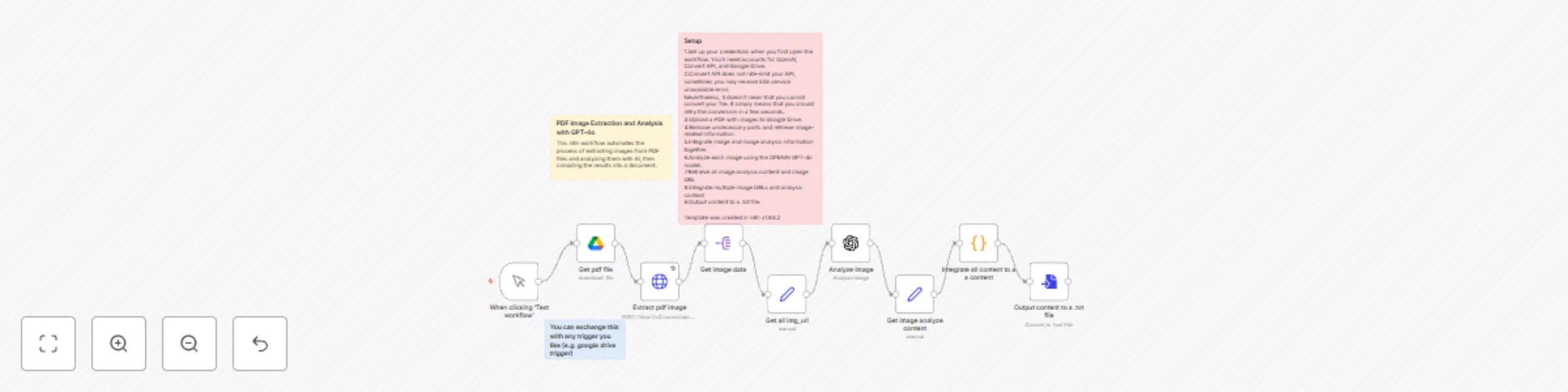
Workflow preview
100%
Automate PDF image extraction & analysis with GPT-4o and Google Drive preview
Open on n8n.io

Important notice

This workflow is provided as-is. Please review and test before using in production.

1. Workflow Overview

Use Case Manually extracting images from PDF files for analysis is often slow and inefficient. Many users resort to taking screenshots of each page, uploading them to an AI tool like OpenAI for ima...

Best for

  • Document Extraction automation workflows
  • Multimodal AI automation workflows
  • intermediate n8n builders looking for reusable templates

Tools used

n8n-nodes-base.manualtrigger, n8n-nodes-base.stickynote, n8n-nodes-base.googledrive, n8n-nodes-base.set, @n8n/n8n-nodes-langchain.openai, n8n-nodes-base.httprequest, n8n-nodes-base.splitout, n8n-nodes-base.code

Source and attribution

This workflow is cataloged by N8N Workflows and links back to its original n8n.io source page by merfy.

Original n8n.io source

1.1 Workflow description

Title
Automate PDF image extraction & analysis with GPT-4o and Google Drive
Workflow name
Automate PDF image extraction & analysis with GPT-4o and Google Drive

Use Case

Manually extracting images from PDF files for analysis is often slow and inefficient. Many users resort to taking screenshots of each page, uploading them to an AI tool like OpenAI for image analysis, and then manually copying the insights into a document. This manual process is time-consuming and prone to errors.

This workflow streamlines the entire process by automatically extracting images from a PDF, analyzing them using the GPT-4o model, and saving the results in seconds—eliminating the need for manual effort.

What This Workflow Does

Extracts all images from the uploaded PDF file automatically The workflow scans each page of the PDF and identifies embedded images without manual intervention.

Uses the GPT-4o model to analyze each extracted image

Each image is processed through GPT-4o to generate descriptive insights, summaries, or context-specific analysis depending on the use case.

Saves the analysis results to a .txt file, including image URLs The final output is a plain text file containing both the image URLs (e.g., hosted on cloud storage) and the corresponding GPT-4o analysis, ready for further use or sharing.

Setup

1.Set up your credentials when you first open the workflow. You’ll need accounts for OpenAI, Convert API, and Google Drive.

2.Convert API does not rate-limit your API, sometimes you may receive 503 service unavailable error.

Nevertheless, it doesn’t mean that you cannot convert your file. It simply means that you should retry the conversion in a few seconds.

3.Upload a PDF with images to Google Drive.

4.Remove unnecessary parts and retrieve image-related information.

5.Integrate image and image analysis information together.

6.Analyze each image using the OPENAI GPT-4o model.

7.Retrieve all image analysis content and image URL

8.Integrate multiple image URLs and analysis content

9.Output content to a .txt file.

Template was created in n8n v1.83.2

How to Customize

Replace the manual trigger with a Google Drive trigger or other automation triggers

Change the image analysis model (e.g., switch or fine-tune GPT-4o)

Send the results to other platforms (e.g., Slack, Telegram, LINE, etc.) instead of saving to a .txt file

1.2 Logical Blocks

This catalog entry is organized from the workflow JSON. The node-level section below shows the executable blocks available for review before importing the template.

2. Block-by-Block Analysis

Block 1 - When clicking ‘Test workflow’

Type / Role
n8n-nodes-base.manualTrigger - manualTrigger
Config choices
Version 1

Block 2 - Sticky Note

Type / Role
n8n-nodes-base.stickyNote - stickyNote
Config choices
Version 1

Block 3 - Get pdf file

Type / Role
n8n-nodes-base.googleDrive - googleDrive
Config choices
Version 3

Block 4 - Get all img_url

Type / Role
n8n-nodes-base.set - set
Config choices
Version 3.4

Block 5 - Analyze image

Type / Role
@n8n/n8n-nodes-langchain.openAi - openAi
Config choices
Version 1.8

Block 6 - Extract pdf image

Type / Role
n8n-nodes-base.httpRequest - httpRequest
Config choices
Version 4.2

Block 7 - Sticky Note1

Type / Role
n8n-nodes-base.stickyNote - stickyNote
Config choices
Version 1

Block 8 - Get image data

Type / Role
n8n-nodes-base.splitOut - splitOut
Config choices
Version 1

Block 9 - Sticky Note3

Type / Role
n8n-nodes-base.stickyNote - stickyNote
Config choices
Version 1

Block 10 - Get image analyze content

Type / Role
n8n-nodes-base.set - set
Config choices
Version 3.4

Block 11 - Integrate all content to a a content

Type / Role
n8n-nodes-base.code - code
Config choices
Version 2

Block 12 - Output content to a .txt file

Type / Role
n8n-nodes-base.convertToFile - convertToFile
Config choices
Version 1.1

3. Summary Table

Workflow Automate PDF image extraction & analysis with GPT-4o and Google Drive
Complexity intermediate
Nodes 12
Categories Document Extraction, Multimodal AI
Author merfy
Published 16 Apr 2025

4. Reproducing the Workflow from Scratch

  1. 1. Download the workflow JSON

    Use the JSON export at /data/workflows/3567/3567.json as the source template for this automation.

  2. 2. Import the template into n8n

    Open n8n, import the downloaded JSON, and review each node before activating the workflow.

  3. 3. Configure credentials and variables

    Replace placeholder credentials, API keys, webhook URLs, account IDs, and environment-specific values with your own settings.

  4. 4. Test with sample data

    Run the workflow manually or in a staging workspace, inspect node output, and confirm downstream systems receive the expected data.

  5. 5. Activate and monitor

    Enable the workflow only after testing, then monitor executions, errors, and rate limits during the first production runs.

5. General Notes & Resources

Review imported nodes carefully before activation. This catalog entry is intended to help you inspect the workflow structure, understand required services, and find related templates faster.

Node names, credentials, schedules, webhook paths, and external service limits may need adjustment for your workspace.

Frequently asked questions

What does Automate PDF image extraction & analysis with GPT-4o and Google Drive do?

Use Case Manually extracting images from PDF files for analysis is often slow and inefficient. Many users resort to taking screenshots of each page, uploading them to an AI tool like OpenAI for ima...

What do I need before importing this workflow?

Review the workflow JSON, configure any required credentials in n8n, and test the automation in a safe workspace before using it in production.

Can I customize this workflow?

Yes. Use the block-by-block analysis and the downloadable JSON to inspect each node, then adjust credentials, prompts, schedules, filters, or destinations for your Document Extraction, Multimodal AI use case.



