I

Ibrahim Emre POLAT

2
Workflows

Workflows by Ibrahim Emre POLAT

Workflow preview: Automate PDF invoice generation & delivery with Gmail and Google Drive storage
Free intermediate

Automate PDF invoice generation & delivery with Gmail and Google Drive storage

## How it works Automatically generates professional PDF invoices from webhook data and delivers them via email while storing backups in Google Drive. Perfect for freelancers, small businesses, and service providers who need automated billing workflows. ## Set up steps Configure environment variables for company information (name, address, email, phone). Set up your PDF generation API service account (PDFShift recommended). Configure SMTP email credentials for invoice delivery. Set up Google Drive OAuth2 for cloud storage. Deploy the workflow and test with sample invoice data. ## Key features - Smart invoice number generation if not provided - Automatic tax calculations with configurable rates - Professional HTML templates with company branding - Parallel processing for email and storage - Comprehensive error handling and validation - Detailed success confirmation responses ## Required environment variables - `COMPANY_NAME` - Your business name - `COMPANY_ADDRESS` - Business mailing address - `COMPANY_EMAIL` - Billing contact email - `COMPANY_PHONE` - Business phone number - `PDF_API_URL` - PDF generation service endpoint - `PDF_API_KEY` - API authentication key - `GDRIVE_INVOICE_FOLDER_ID` - Google Drive folder ID ## API requirements PDF generation service (PDFShift, HTML/CSS to PDF API, or similar), SMTP email service for delivery, Google Drive API access for storage. ## Input format ```json { "customerName": "John Smith", "customerEmail": "[email protected]", "items": [ {"description": "Web Design", "quantity": 1, "price": 500} ], "dueDate": "2025-02-15" }

I
Ibrahim Emre POLAT
Invoice Processing
9 Sep 2025
446
0
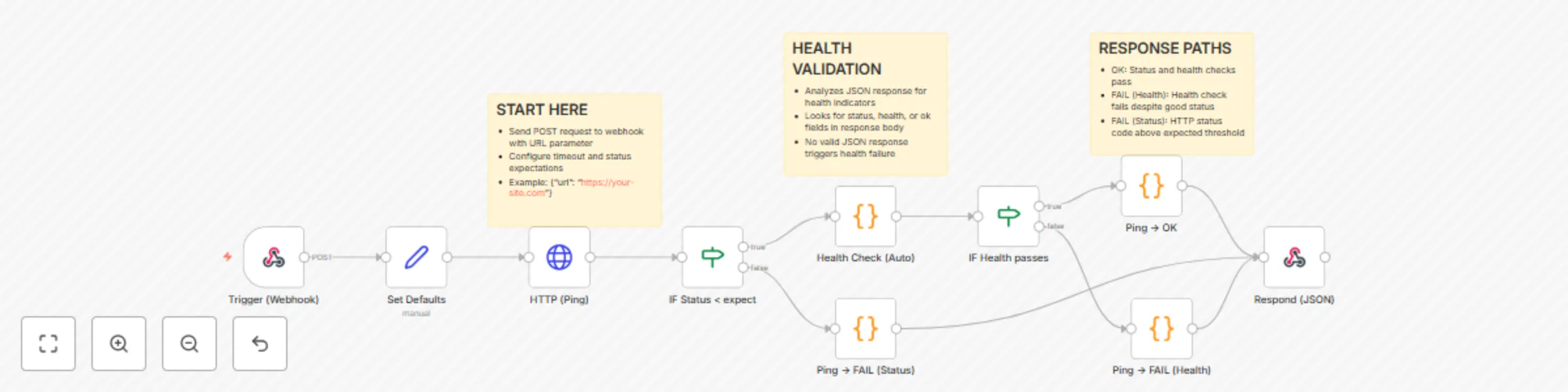
Workflow preview: Website & API health monitoring system with HTTP status validation
Free intermediate

Website & API health monitoring system with HTTP status validation

## Website & API Health Monitoring System with HTTP Status Validation ## How it works - Performs HTTP health checks on websites and APIs with automatic health status validation - Checks HTTP status codes and analyzes JSON responses for common health indicators - Returns detailed status information including response times and health status - Implements conditional logic to handle different response scenarios - Perfect for monitoring dashboards, alerts, and automated health checks ## Set up steps - Deploy the workflow and activate it - Get the webhook URL from the trigger node - Configure your monitoring system to call the webhook endpoint - Send POST requests with target URLs for health monitoring - Receive JSON responses with health status, HTTP codes, and timestamps ## Usage - Send POST requests to the webhook URL with target URL parameter - Optionally configure timeout and status expectations in request body - Receive JSON responses with health status, HTTP codes, and timestamps - Perfect for monitoring dashboards, alerts, and automated health checks - Use with external monitoring tools like Nagios, Zabbix, or custom dashboards - Set up scheduled monitoring calls for continuous health validation - Example request: Send POST with `{"url": "https://your-site.com", "timeoutMs": 5000}` - Success response returns: `{"ok": true, "statusCode": 200, "healthStatus": "ok"}` - Failure response returns: `{"ok": false, "error": "Health check failed", "statusCode": 503}` ## Benefits - Proactive monitoring to identify issues before they impact users - Detailed diagnostics with comprehensive health data for troubleshooting - Integration ready - works with existing monitoring and alerting systems - Customizable timeout settings, expected status codes, and health indicators - Scalable solution to monitor multiple services with single workflow endpoint ## Use Cases - E-commerce platforms: Monitor payment APIs, inventory systems, user authentication - Microservices: Health validation for distributed service architectures - API gateways: Endpoint monitoring with response time validation - Database connections: Track connectivity and performance metrics - Third-party integrations: Monitor external API dependencies and SLA compliance ## Target Audience - DevOps Engineers implementing production monitoring - System Administrators managing server uptime - Site Reliability Engineers building monitoring systems - Development Teams tracking API health in staging/production - IT Support Teams for proactive issue detection

I
Ibrahim Emre POLAT
DevOps
9 Sep 2025
847
0