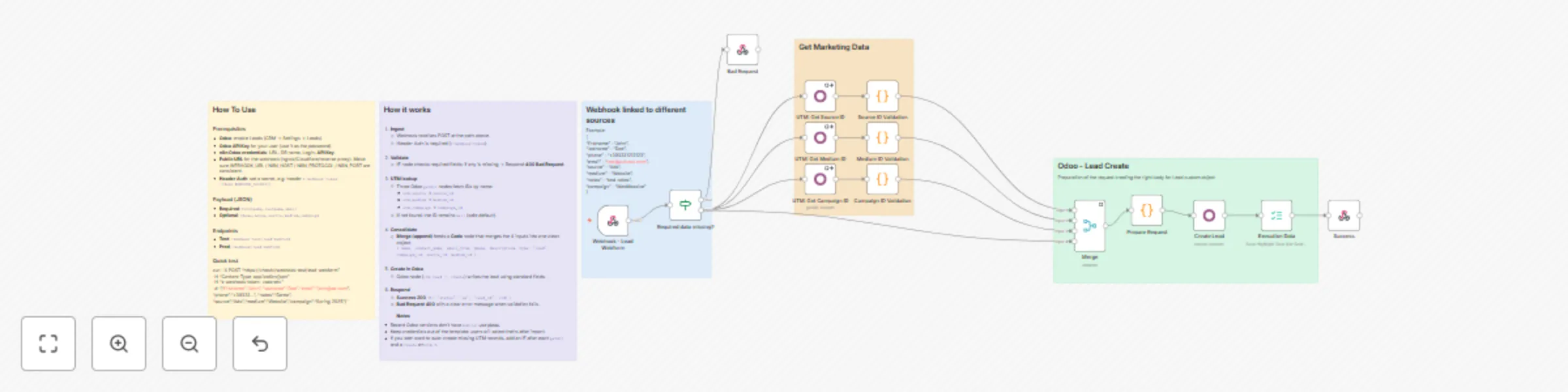
Secure web form to Odoo CRM lead creation with UTM tracking
# Web-to-Odoo Lead Funnel (UTM-ready)
Create `crm.lead` records in Odoo from any webform via a secure webhook.
The workflow validates required fields, resolves UTMs **by name** (source, medium, campaign) and writes standard lead fields in Odoo. Clean, portable, and production-ready.
## Key features
- ✅ **Secure Webhook** with Header Auth (`x-webhook-token`)
- ✅ **Required fields validation** (`firstname`, `lastname`, `email`)
- ✅ **UTM lookup by name** (`utm.source`, `utm.medium`, `utm.campaign`)
- ✅ **Clean consolidation** before create (`name`, `contact_name`, `email_from`, `phone`, `description`, `type`, UTM IDs)
- ✅ **Clear HTTP responses**: `200` success / `400` bad request
## Prerequisites
- Odoo with **Leads** enabled (CRM → Settings → Leads)
- **Odoo API Key** for your user (use it as the password)
- n8n **Odoo credentials**: URL, DB name, Login, API Key
- **Public URL** for the webhook (ngrok/Cloudflare/reverse proxy). Ensure `WEBHOOK_URL` / `N8N_HOST` / `N8N_PROTOCOL` / `N8N_PORT` are consistent
- **Header Auth secret** (e.g., `x-webhook-token: <your-secret>`)
## How it works
1. **Ingest** – The Webhook receives a POST at `/webhook(-test)/lead-webform` with Header Auth.
2. **Validate** – An IF node checks required fields; if missing → respond with `400 Bad Request`.
3. **UTM lookup** – Three Odoo `getAll` queries fetch IDs by `name`:
- `utm.source` → `source_id`
- `utm.medium` → `medium_id`
- `utm.campaign` → `campaign_id`
If a record is not found, the corresponding ID remains `null`.
4. **Consolidate** – Merge + Code nodes produce a single clean object:
`{ name, contact_name, email_from, phone, description, type: "lead", campaign_id, source_id, medium_id }`
5. **Create in Odoo** – Odoo node (`crm.lead → create`) writes the lead with standard fields + UTM Many2one IDs.
6. **Respond** – Success node returns `200` with `{ status: "ok", lead_id }`.
## Payload (JSON)
**Required:** `firstname`, `lastname`, `email`
**Optional:** `phone`, `notes`, `source`, `medium`, `campaign`
```json
{
"firstname": "John",
"lastname": "Doe",
"email": "[email protected]",
"phone": "+393331234567",
"notes": "Wants a demo",
"source": "Ads",
"medium": "Website",
"campaign": "Spring 2025"
}
```
## Quick test
```bash
curl -X POST "https://<host>/webhook-test/lead-webform" \
-H "Content-Type: application/json" \
-H "x-webhook-token: <secret>" \
-d '{"firstname":"John","lastname":"Doe","email":"[email protected]",
"phone":"+39333...", "notes":"Demo",
"source":"Ads","medium":"Website","campaign":"Spring 2025"}'
```
## Notes
- Recent Odoo versions do not use the `mobile` field on leads/partners: use `phone` instead.
- Keep **secrets and credentials** out of the template; the user will set their own after import.
- If you want to **auto-create** missing UTM records, add an IF after each `getAll` and a `create` on `utm.*`.